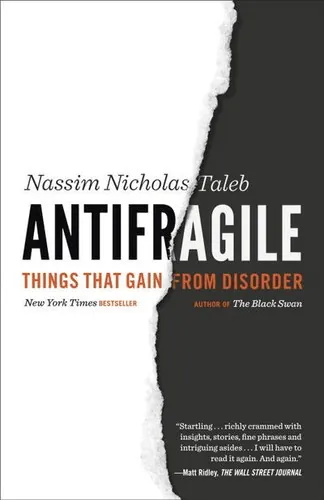
Antifragile: Things That Gain from Disorder
Listen to it free. Get Antifragile on Audible with a free trial for eligible new members — cancel anytime.
Start listening freeon AudibleNew members only · many titles are included with the membership. As an Amazon Associate, Read Stacks earns from qualifying purchases and membership trials at no extra cost to you.
What this book is, and who it's for
Nassim Nicholas Taleb's 2012 book gave us the word for things that gain from stress — and once you have the word, you start seeing it everywhere. The triad (fragile breaks under disorder, robust endures it, antifragile improves because of it) reorganizes how you think about your career, your investments, your routines, your institutions, and your body. Taleb's argument, drawn from finance, evolution, medicine, and history, is that the modern reflex to eliminate volatility usually produces fragility — over-medicated patients, over-protected children, over-bailed-out banks, over-optimized supply chains that crack on the first real shock. The alternative is to design for antifragility: small frequent stresses that build capacity, optionality preserved at low cost, skin in the game, the barbell strategy that combines safety floor with speculative upside. Read this when you've noticed that smoothing out the disturbances in your life seems to be producing more fragility, not less.
The property of systems that gain from disorder, randomness, and stressors — the opposite of fragile, beyond merely robust. Taleb's central contribution to risk theory and a frame for designing positions that benefit from shocks.
How to apply Antifragile in 3 steps
- 1Audit your positions for fragility
For your career, finances, key relationships: which would BREAK under moderate shocks (job loss, market downturn, single relationship ending)? Each fragile position is a liability the shock will eventually find. Taleb's first contribution is making them visible.
- 2Build optionality where the fragility is
Convert fragile positions to antifragile ones via the barbell: extreme safety on most of your exposure + small bets on high-upside risk. Job: keep day job + 10% time on a side venture. Finances: index funds + a small high-risk allocation. Relationships: deep + broad rather than only deep or only broad.
- 3Seek stressors that strengthen
Identify the small voluntary stressors that make systems antifragile — exercise for the body, hard conversations for relationships, learning sprints for skills, real-money-small-stakes bets for judgment. The stressors that don't break you build the capacity for the larger shocks that will eventually arrive.
Chapters
- Chapter 1Between Damocles and Hydra1.5 min
- Chapter 2Overcompensation1.5 min
- Chapter 3The Cat and the Washing Machine1.5 min
- Chapter 4What Kills Me Makes Others Stronger1.5 min
- Chapter 5Tinkering and the Discovery of Antifragility1.5 min
- Chapter 6The Lecturing-Birds-How-to-Fly Effect1.5 min
- Chapter 7Skin in the Game1.5 min
- Chapter 8The Logic of Disorder1.5 min
- Chapter 9Time and Fragility2 min
- Chapter 10Iatrogenics: The Harm of the Healer2 min
How to read this book. Each chapter is a ~30-second summary — the core insight, no filler. Open the chapters that grab you. If the book resonates, hear the full audiobook free with an Audible trial or buy the edition on Amazon (links below, affiliate-disclosed).
Antifragile pairs well with
A single book is an argument. A stack is a curriculum. Antifragile appears in this curated reading path — each pairs it with other books that sharpen its ideas, in a suggested reading order.
More books like Antifragile
The other books in the curated reading paths Antifragile belongs to. Each one sharpens, extends, or counter-argues something Antifragile establishes — the compound is the reason these books sit together in a stack.
- Master power dynamicsThe Art of WarSun Tzu
- Master power dynamicsThe 48 Laws of PowerRobert Greene
- Master power dynamicsThe Laws of Human NatureRobert Greene
- Master power dynamicsPre-SuasionRobert Cialdini
- Master power dynamicsNever Split the DifferenceChris Voss
- Master power dynamicsSkin in the GameNassim Nicholas Taleb
- Master power dynamicsTalking to StrangersMalcolm Gladwell
Frequently asked questions
What is Antifragile about?+
Nassim Nicholas Taleb's 2012 book gave us the word for things that gain from stress — and once you have the word, you start seeing it everywhere.
How long does it take to read Antifragile?+
The full Antifragile typically takes 4-6 hours to read cover-to-cover. The Read Stacks chapter summaries cover the same ideas in ~17 minutes total (10 chapters at ~30 seconds each).
Who is Antifragile for?+
Antifragile is widely regarded as essential reading in its field. The Read Stacks summary is the fastest way to decide if the full book is worth your time before committing to it.
What are the key ideas in Antifragile?+
The book covers Between Damocles and Hydra, Overcompensation, The Cat and the Washing Machine, What Kills Me Makes Others Stronger and Tinkering and the Discovery of Antifragility. Each chapter has a free summary on Read Stacks (~30 seconds each).
Is Antifragile worth reading?+
If you're interested in the ideas in Antifragile, Antifragile is widely considered essential. The Read Stacks chapter summaries help you decide — read the free first chapter, then buy the full book on Amazon if the argument resonates.
Books like Antifragile
If Antifragile resonated, these non-fiction books pick up the same threads.
From Read Stacks · Learn
How to get more out of this book
Three short guides: how to take notes on a non-fiction book, how to summarise a chapter in your own words, and the retention techniques that decide whether what you read here is still useful six months from now.
- How do I take notes on a non-fiction book?
Decide what the notes are for, read a full section before writing, and use the same short layout for every chapter: claim, reasons, evidence, terms and your own response, all in your own words with page numbers. Turn each note into questions for review, and finish with a one-page summary of the whole book.
5 min read
- How do I summarise a non-fiction chapter?
Read the chapter's opening and closing pages first, write its main claim as one sentence, list the two to four reasons the author gives and the best piece of evidence, then close the book and write a short paragraph from memory. Check it against the text and add one clearly labelled line of your own.
5 min read
- I read a lot of books but can't remember anything. What works?
Forgetting most of what you read is normal, not a personal failing — your brain wasn't designed to retain prose at the rate modern readers consume it. The practices that DO work share one thing: they force you to USE the material instead of just consuming it. Six specific techniques, each tested across decades.
7 min read
Appears in these topics
Antifragile is part of 3 curated reading lists — each a “best books on X” cluster with a synthesis on how the books fit together.