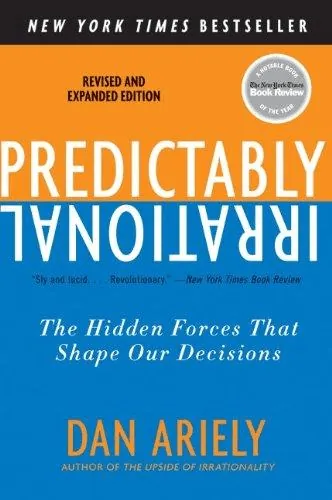
Predictably Irrational: The Hidden Forces That Shape Our Decisions
by Dan Ariely
Listen to it free. Get Predictably Irrational on Audible with a free trial for eligible new members — cancel anytime.
Start listening freeon AudibleNew members only · many titles are included with the membership. As an Amazon Associate, Read Stacks earns from qualifying purchases and membership trials at no extra cost to you.
What this book is, and who it's for
Dan Ariely's 2008 book is the most-read introduction to behavioral economics and is built around his Duke University lab's experiments documenting the specific ways human decision-making departs from the rational-agent model of classical economics. The departures are not random; they are predictable and consistent across populations. Anchoring effects, the disproportionate power of free, the destructive consequences of mixing market norms and social norms, the unreliability of cold-state planning for hot-state decisions, ownership-based valuation distortions, optionality bias, expectation-shaped experience, price-shaped placebo effects, small-stakes dishonesty and its sensitivity to environmental cues — each chapter documents a specific bias and the experimental evidence underlying it. The book's deeper argument is that the predictability of these biases means decisions and institutions can be engineered around them rather than relying on willpower or rational analysis. Read this when you've noticed that the standard economics models do not actually describe how you make decisions, or when you're designing systems (products, organizations, choice architectures) and want to anticipate how users will actually behave rather than how the model says they should.
Ariely's experimental finding that humans depart from rational-agent models in specific, replicable, engineerable ways. The departures are not random; they are predictable patterns that can be designed for (or against) in products, policies, and personal decisions.
How to apply Predictably Irrational in 3 steps
- 1Recognize the bias as it operates on you
In your next consumer decision, name which Ariely bias is firing — anchoring, free-as-special-category, loss aversion, present bias. The naming dissolves about half the influence. The unnamed bias operates unconsciously; the named one becomes a deliberate choice.
- 2Engineer around your future weakness
For decisions you know you'll make poorly under temptation (diet, spending, attention, work-vs-rest), pre-commit when calm. Remove the option from the environment. Sign up for the auto-deduction. Block the site at the OS level. Willpower at the moment is unreliable; structural pre-commitment is durable.
- 3Design choices for others ethically
If you build products, design organizations, or shape policy, you're inevitably shaping behavior through choice architecture. Ariely's findings give you the tools. Use them to make the right thing the easy default — for the user's own benefit, not just for your conversion rate.
Chapters
- Chapter 1The Truth About Relativity2 min
- Chapter 2The Fallacy of Supply and Demand1.5 min
- Chapter 3The Cost of Zero Cost1.5 min
- Chapter 4The Cost of Social Norms2 min
- Chapter 5The Influence of Arousal1.5 min
- Chapter 6The Problem of Procrastination and Self-Control1.5 min
- Chapter 7The High Price of Ownership2 min
- Chapter 8Keeping Doors Open2 min
- Chapter 9The Effect of Expectations1.5 min
- Chapter 10The Power of Price1.5 min
- Chapter 11The Context of Our Character, Part I1.5 min
- Chapter 12The Context of Our Character, Part II1.5 min
- Chapter 13Beer and Free Lunches2 min
How to read this book. Each chapter is a ~30-second summary — the core insight, no filler. Open the chapters that grab you. If the book resonates, hear the full audiobook free with an Audible trial or buy the edition on Amazon (links below, affiliate-disclosed).
Predictably Irrational pairs well with
A single book is an argument. A stack is a curriculum. Predictably Irrational appears in this curated reading path — each pairs it with other books that sharpen its ideas, in a suggested reading order.
More books like Predictably Irrational
The other books in the curated reading paths Predictably Irrational belongs to. Each one sharpens, extends, or counter-argues something Predictably Irrational establishes — the compound is the reason these books sit together in a stack.
Frequently asked questions
What is Predictably Irrational about?+
Dan Ariely's 2008 book is the most-read introduction to behavioral economics and is built around his Duke University lab's experiments documenting the specific ways human decision-making departs from the rational-agent model of classical economics.
How long does it take to read Predictably Irrational?+
The full Predictably Irrational typically takes 4-6 hours to read cover-to-cover. The Read Stacks chapter summaries cover the same ideas in ~22.5 minutes total (13 chapters at ~30 seconds each).
Who is Predictably Irrational for?+
Predictably Irrational is for readers curious about why people think and decide the way they do. Useful for designers, marketers, negotiators, and anyone making decisions with imperfect information.
What are the key ideas in Predictably Irrational?+
The book covers The Truth About Relativity, The Fallacy of Supply and Demand, The Cost of Zero Cost, The Cost of Social Norms and The Influence of Arousal. Each chapter has a free summary on Read Stacks (~30 seconds each).
Is Predictably Irrational worth reading?+
If you're interested in cognitive bias and clearer decision-making, Predictably Irrational is widely considered essential. The Read Stacks chapter summaries help you decide — read the free first chapter, then buy the full book on Amazon if the argument resonates.
Books like Predictably Irrational
If Predictably Irrational resonated, these non-fiction books pick up the same threads.
From Read Stacks · Learn
How to get more out of this book
Three short guides: how to take notes on a non-fiction book, how to summarise a chapter in your own words, and the retention techniques that decide whether what you read here is still useful six months from now.
- How do I take notes on a non-fiction book?
Decide what the notes are for, read a full section before writing, and use the same short layout for every chapter: claim, reasons, evidence, terms and your own response, all in your own words with page numbers. Turn each note into questions for review, and finish with a one-page summary of the whole book.
5 min read
- How do I summarise a non-fiction chapter?
Read the chapter's opening and closing pages first, write its main claim as one sentence, list the two to four reasons the author gives and the best piece of evidence, then close the book and write a short paragraph from memory. Check it against the text and add one clearly labelled line of your own.
5 min read
- I read a lot of books but can't remember anything. What works?
Forgetting most of what you read is normal, not a personal failing — your brain wasn't designed to retain prose at the rate modern readers consume it. The practices that DO work share one thing: they force you to USE the material instead of just consuming it. Six specific techniques, each tested across decades.
7 min read
Appears in these topics
Predictably Irrational is part of 2 curated reading lists — each a “best books on X” cluster with a synthesis on how the books fit together.