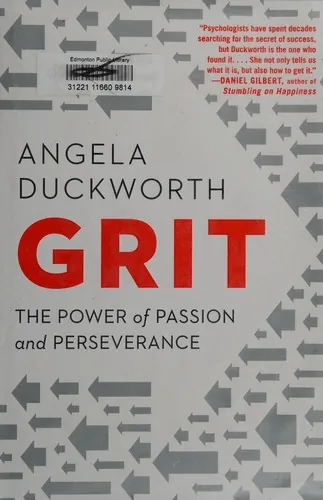
Grit: The Power of Passion and Perseverance
Listen to it free. Get Grit on Audible with a free trial for eligible new members — cancel anytime.
Start listening freeon AudibleNew members only · many titles are included with the membership. As an Amazon Associate, Read Stacks earns from qualifying purchases and membership trials at no extra cost to you.
What this book is, and who it's for
Angela Duckworth's 2016 book operationalizes a decade of her own research at Penn, showing that across domains from West Point cadets to spelling-bee finalists to corporate sales teams, the single best predictor of long-term success is not talent but grit — the combination of passion for a long-term goal and perseverance through the inevitable setbacks. The book's gift is that it does not stop at the diagnosis. Duckworth identifies the four assets that develop grit (interest, practice, purpose, hope) and shows how each can be cultivated deliberately, by anyone, at any age. Read this when you've noticed that the people who finish things are not necessarily the people who started with more talent than you did.
Passion plus perseverance applied to a single long-term goal over years and decades. Duckworth's research identifies it as a better predictor of finishing what one starts than IQ, talent, or socioeconomic background.
How to apply Grit in 3 steps
- 1Identify your single long-term goal
Most career energy gets dissipated across many medium-term goals. Pick ONE long-term goal (5-10 years out) that organizes the others. The exercise is uncomfortable because committing to one means de-prioritizing others; that's the point.
- 2Practice deliberately at the edge of your capability
Daily, work for an hour at the part of your craft that you can't yet do well — the failure-prone zone where improvement actually happens. Most professionals coast on what they already do well; gritty performers stay in the discomfort zone.
- 3Find hope inside setbacks
When the long-term goal feels hopeless mid-stream (year 3, year 5), Duckworth's research is clear: the gritty don't lack the doubts, they continue working through them. Pre-commit to continuing for at least a year through the next valley. The continuing is the work.
Chapters
How to read this book. Each chapter is a ~30-second summary — the core insight, no filler. Open the chapters that grab you. If the book resonates, hear the full audiobook free with an Audible trial or buy the edition on Amazon (links below, affiliate-disclosed).
Grit pairs well with
A single book is an argument. A stack is a curriculum. Grit appears in this curated reading path — each pairs it with other books that sharpen its ideas, in a suggested reading order.
More books like Grit
The other books in the curated reading paths Grit belongs to. Each one sharpens, extends, or counter-argues something Grit establishes — the compound is the reason these books sit together in a stack.
- Build better habitsThe 7 Habits of Highly Effective PeopleStephen R. Covey
- Build better habitsThe Power of HabitCharles Duhigg
- Build better habitsAtomic HabitsJames Clear
- Build better habitsDeep WorkCal Newport
- Build better habitsEssentialismGreg McKeown
- Build better habitsSo Good They Can't Ignore YouCal Newport
- Build better habitsPeakAnders Ericsson & Robert Pool
Frequently asked questions
What is Grit about?+
Angela Duckworth's 2016 book operationalizes a decade of her own research at Penn, showing that across domains from West Point cadets to spelling-bee finalists to corporate sales teams, the single best predictor of long-term success is not talent but grit — the combination of passion for a long-term goal and….
How long does it take to read Grit?+
The full Grit typically takes 4-6 hours to read cover-to-cover. The Read Stacks chapter summaries cover the same ideas in ~17 minutes total (10 chapters at ~30 seconds each).
Who is Grit for?+
Grit is widely regarded as essential reading in its field. The Read Stacks summary is the fastest way to decide if the full book is worth your time before committing to it.
What are the key ideas in Grit?+
The book covers Showing Up, Distracted by Talent, Effort Counts Twice, How Gritty Are You? and Grit Grows. Each chapter has a free summary on Read Stacks (~30 seconds each).
Is Grit worth reading?+
If you're interested in the ideas in Grit, Grit is widely considered essential. The Read Stacks chapter summaries help you decide — read the free first chapter, then buy the full book on Amazon if the argument resonates.
Books like Grit
If Grit resonated, these non-fiction books pick up the same threads.
From Read Stacks · Learn
How to get more out of this book
Three short guides: how to take notes on a non-fiction book, how to summarise a chapter in your own words, and the retention techniques that decide whether what you read here is still useful six months from now.
- How do I take notes on a non-fiction book?
Decide what the notes are for, read a full section before writing, and use the same short layout for every chapter: claim, reasons, evidence, terms and your own response, all in your own words with page numbers. Turn each note into questions for review, and finish with a one-page summary of the whole book.
5 min read
- How do I summarise a non-fiction chapter?
Read the chapter's opening and closing pages first, write its main claim as one sentence, list the two to four reasons the author gives and the best piece of evidence, then close the book and write a short paragraph from memory. Check it against the text and add one clearly labelled line of your own.
5 min read
- I read a lot of books but can't remember anything. What works?
Forgetting most of what you read is normal, not a personal failing — your brain wasn't designed to retain prose at the rate modern readers consume it. The practices that DO work share one thing: they force you to USE the material instead of just consuming it. Six specific techniques, each tested across decades.
7 min read
Appears in these topics
Grit is part of 3 curated reading lists — each a “best books on X” cluster with a synthesis on how the books fit together.