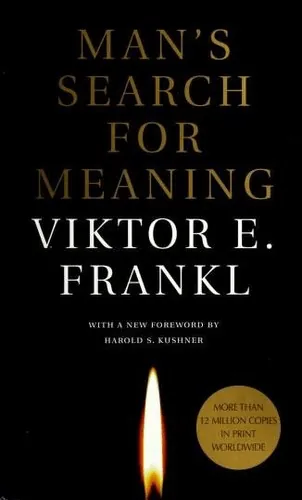
Man’s Search for Meaning
Listen to it free. Get Man’s Search for Meaning on Audible with a 30-day trial — cancel anytime.
Start listening freeon AudibleNew members only · many titles are included with the membership. As an Amazon Associate, Read Stacks earns from qualifying purchases and membership trials at no extra cost to you.
What this book is, and who it's for
Viktor Frankl's 1946 account of surviving the Nazi concentration camps doubles as the founding document of logotherapy — the psychotherapy that takes meaning, rather than pleasure or power, as humanity's primary drive. The book is short, brutal, and stripped of decoration: Frankl writes about Auschwitz from inside Auschwitz, and the second half outlines what he later treated patients with for decades. The argument that survives compression: meaning is found, not given, and humans without an orientation toward something larger than themselves break under far less stress than humans who have one. Read this when you need to remember the floor argument.
Frankl's therapeutic approach, formed in the concentration camps: the primary human drive is the search for meaning, not pleasure or power. When meaning is found, even unbearable suffering becomes survivable.
How to apply Man's Search for Meaning in 3 steps
- 1Find the meaning in your current circumstance
Whatever situation you're in — even one you'd rather not be in — Frankl's logotherapy asks: what meaning is available to you here? Not in some better version of life, in this one. The question is uncomfortable but the answer is usually findable when you look.
- 2Choose your attitude to what you can't change
For the part of your situation outside your control, the freedom you retain is your response to it. Frankl earned the right to make this claim in conditions no reader will face. The discipline is choosing the response that aligns with who you'd want to be afterward.
- 3Live for something bigger than yourself
Frankl's clinical observation: people oriented toward something beyond themselves (work, others, a cause) survive crises that destroy people oriented only toward self-actualization. Identify what you serve. Reorient daily life around the service. The orientation is the meaning.
Opening
Closing & reference
- AfterwordMan’s Search for Meaning1.5 min
- ChapterCritique of Pan-Determinism1.5 min
- ChapterExistential Frustration1.5 min
- ChapterFirst Phase: Shock2 min
- ChapterNoö-dynamics1.5 min
- ChapterNoogenic Neuroses2 min
- ChapterParadoxical Intention1.5 min
- ChapterPart One: Experiences in a Concentration Camp2 min
- ChapterPart Two: Logotherapy in a Nutshell2 min
- ChapterPostscript 1984: The Case for a Tragic Optimism1.5 min
- ChapterPREFACE TO THE 1992 EDITION2 min
- ChapterPsychiatry Rehumanized1.5 min
- ChapterSecond Phase: Apathy2 min
- ChapterThe Collective Neurosis1.5 min
- ChapterThe Essence of Existence1.5 min
- ChapterThe Existential Vacuum1.5 min
- ChapterThe Meaning of Life1.5 min
- ChapterThe Meaning of Love1.5 min
- ChapterThe Meaning of Suffering2 min
- ChapterThe Psychiatric Credo1.5 min
- ChapterThe Super-Meaning1.5 min
- ChapterThe Will to Meaning1.5 min
- ChapterThird Phase: After Liberation2 min
How to read this book. Each chapter is a ~30-second summary — the core insight, no filler. Open the chapters that grab you. If the book resonates, hear the full audiobook free with an Audible trial or buy the edition on Amazon (links below, affiliate-disclosed).
Man’s Search for Meaning pairs well with
A single book is an argument. A stack is a curriculum. Man’s Search for Meaning appears in this curated reading path — each pairs it with other books that sharpen its ideas, in a suggested reading order.
More books like Man’s Search for Meaning
The other books in the curated reading paths Man’s Search for Meaning belongs to. Each one sharpens, extends, or counter-argues something Man’s Search for Meaning establishes — the compound is the reason these books sit together in a stack.
- Find meaningMeditationsMarcus Aurelius
- Find meaningThe Obstacle Is the WayRyan Holiday
- Find meaningThe Courage to Be DislikedIchiro Kishimi & Fumitake Koga
- Find meaningSapiensYuval Noah Harari
- Find meaningHomo DeusYuval Noah Harari
- Find meaningEssentialismGreg McKeown
- Find meaningTribeSebastian Junger
- Find meaningEgo Is the EnemyRyan Holiday
Related reading guides: Friedrich Nietzsche, Søren Kierkegaard and Albert Camus.
Frequently asked questions
What is Man’s Search for Meaning about?+
Viktor Frankl's 1946 account of surviving the Nazi concentration camps doubles as the founding document of logotherapy — the psychotherapy that takes meaning, rather than pleasure or power, as humanity's primary drive.
How long does it take to read Man’s Search for Meaning?+
The full Man’s Search for Meaning typically takes 4-6 hours to read cover-to-cover. The Read Stacks chapter summaries cover the same ideas in ~41.5 minutes total (24 chapters at ~30 seconds each).
Who is Man’s Search for Meaning for?+
Man’s Search for Meaning is widely regarded as essential reading in its field. The Read Stacks summary is the fastest way to decide if the full book is worth your time before committing to it.
What are the key ideas in Man’s Search for Meaning?+
The book covers Critique of Pan-Determinism, Existential Frustration, First Phase: Shock, Noö-dynamics and Noogenic Neuroses. Each chapter has a free summary on Read Stacks (~30 seconds each).
Is Man’s Search for Meaning worth reading?+
If you're interested in the ideas in Man’s Search for Meaning, Man’s Search for Meaning is widely considered essential. The Read Stacks chapter summaries help you decide — read the free first chapter, then buy the full book on Amazon if the argument resonates.
Books like Man’s Search for Meaning
If Man’s Search for Meaning resonated, these non-fiction books pick up the same threads.

From Read Stacks · Learn
How to get more out of this book
Two short essays on the meta-skill — what chapter summaries actually preserve, and the six retention techniques that decide whether what you read here is still useful six months from now.
- Are book summaries actually useful, or am I just cheating?
Chapter summaries are a navigation tool, not a substitute. Used right, they help you read more books fully — by helping you avoid the wrong ones. Used wrong, they're a comfort blanket that lets you feel like you're reading without engaging with the material.
6 min read
- I read a lot of books but can't remember anything. What works?
Forgetting most of what you read is normal, not a personal failing — your brain wasn't designed to retain prose at the rate modern readers consume it. The practices that DO work share one thing: they force you to USE the material instead of just consuming it. Six specific techniques, each tested across decades.
7 min read
Appears in these topics
Man’s Search for Meaning is part of 3 curated reading lists — each a “best books on X” cluster with a synthesis on how the books fit together.