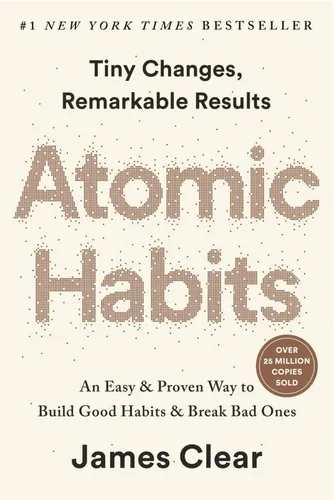
Atomic Habits: An Easy & Proven Way to Build Good Habits & Break Bad Ones
by James Clear
Listen to it free. Get Atomic Habits on Audible with a 30-day trial — cancel anytime.
Start listening freeon AudibleNew members only · many titles are included with the membership. As an Amazon Associate, Read Stacks earns from qualifying purchases and membership trials at no extra cost to you.
What this book is, and who it's for
James Clear's 2018 bestseller did one thing better than any other habit-formation book of the last twenty years: it made the cue-routine-reward loop both Monday-morning actionable AND grounded in actual identity. Atomic Habits is the operating manual where The Power of Habit was the diagnostic. The argument: tiny improvements compound, identity follows behavior (not the reverse), and the four laws — make the cue obvious, the action attractive, the response easy, the reward satisfying — explain why almost every habit attempt fails and how to engineer one that doesn't. Read this if you've already tried willpower and noticed it doesn't last.
A small automatic behavior that, repeated reliably, compounds into identity-level change. Clear's four laws (cue obvious, routine attractive, response easy, reward satisfying) are the engineering instructions for building one.
How to apply Atomic Habits in 3 steps
- 1Identify the cue
Pick ONE habit you want to change. Write down what triggers the existing behavior — time of day, location, emotional state, the action immediately before it. Most habit-change failures start here, with cue-blindness.
- 2Stack onto an existing routine
Choose a habit you already perform reliably (morning coffee, commute, brushing teeth). Append the new habit to it — 'after I pour my coffee, I write three sentences.' The existing routine carries the new behavior past the willpower phase.
- 3Make the next step laughably easy
If the habit is exercise, the next step is 'put on shoes.' If it's writing, it's 'open the document.' Lower the activation energy until starting requires zero willpower. Identity-level change comes from showing up, not from intensity.
Opening
Chapters
- Chapter 1The Surprising Power of Atomic Habits1.5 min
- Chapter 2How Your Habits Shape Your Identity (and Vice Versa)1.5 min
- Chapter 3How to Build Better Habits in 4 Simple Steps2 min
- Chapter 4The Man Who Didn’t Look Right2 min
- Chapter 5The Best Way to Start a New Habit1.5 min
- Chapter 6Motivation Is Overrated; Environment Often Matters More2 min
- Chapter 7The Secret to Self-Control2 min
- Chapter 8How to Make a Habit Irresistible2 min
- Chapter 9The Role of Family and Friends in Shaping Your Habits1.5 min
- Chapter 10How to Find and Fix the Causes of Your Bad Habits2 min
- Chapter 11Walk Slowly, but Never Backward2 min
- Chapter 12The Law of Least Effort2 min
- Chapter 13How to Stop Procrastinating by Using the Two-Minute Rule2 min
- Chapter 14How to Make Good Habits Inevitable and Bad Habits Impossible2 min
- Chapter 15The Cardinal Rule of Behavior Change2 min
- Chapter 16How to Stick with Good Habits Every Day1.5 min
- Chapter 17How an Accountability Partner Can Change Everything2 min
- Chapter 18The Truth About Talent (When Genes Matter and When They Don’t)1.5 min
- Chapter 19The Goldilocks Rule: How to Stay Motivated in Life and Work1.5 min
- Chapter 20The Downside of Creating Good Habits1.5 min
Closing & reference
How to read this book. Each chapter is a ~30-second summary — the core insight, no filler. Open the chapters that grab you. If the book resonates, hear the full audiobook free with an Audible trial or buy the edition on Amazon (links below, affiliate-disclosed).
Atomic Habits pairs well with
A single book is an argument. A stack is a curriculum. Atomic Habits appears in 2 curated reading paths — each pairs it with other books that sharpen its ideas, in a suggested reading order.
More books like Atomic Habits
The other books in the curated reading paths Atomic Habits belongs to. Each one sharpens, extends, or counter-argues something Atomic Habits establishes — the compound is the reason these books sit together in a stack.
- Build better habitsThe 7 Habits of Highly Effective PeopleStephen R. Covey
- Build better habitsThe Power of HabitCharles Duhigg
- Build better habitsDeep WorkCal Newport
- Build better habitsEssentialismGreg McKeown
- Build better habitsGritAngela Duckworth
- Build better habitsSo Good They Can't Ignore YouCal Newport
- Build better habitsPeakAnders Ericsson & Robert Pool
- Win the long gameOutliersMalcolm Gladwell
Frequently asked questions
What is Atomic Habits about?+
James Clear's 2018 bestseller did one thing better than any other habit-formation book of the last twenty years: it made the cue-routine-reward loop both Monday-morning actionable AND grounded in actual identity.
How long does it take to read Atomic Habits?+
The full Atomic Habits typically takes 4-6 hours to read cover-to-cover. The Read Stacks chapter summaries cover the same ideas in ~39.5 minutes total (22 chapters at ~30 seconds each).
Who is Atomic Habits for?+
Atomic Habits is for anyone trying to change how they spend their attention, energy, or time. No specific background required — the ideas apply to personal and professional life equally.
What are the key ideas in Atomic Habits?+
The book covers The Surprising Power of Atomic Habits, How Your Habits Shape Your Identity (and Vice Versa), How to Build Better Habits in 4 Simple Steps, The Man Who Didn’t Look Right and The Best Way to Start a New Habit. Each chapter has a free summary on Read Stacks (~30 seconds each).
Is Atomic Habits worth reading?+
If you're interested in behavior change and habit formation, Atomic Habits is widely considered essential. The Read Stacks chapter summaries help you decide — read the free first chapter, then buy the full book on Amazon if the argument resonates.
Books like Atomic Habits
If Atomic Habits resonated, these non-fiction books pick up the same threads.
From Read Stacks · Learn
How to get more out of this book
Two short essays on the meta-skill — what chapter summaries actually preserve, and the six retention techniques that decide whether what you read here is still useful six months from now.
- Are book summaries actually useful, or am I just cheating?
Chapter summaries are a navigation tool, not a substitute. Used right, they help you read more books fully — by helping you avoid the wrong ones. Used wrong, they're a comfort blanket that lets you feel like you're reading without engaging with the material.
6 min read
- I read a lot of books but can't remember anything. What works?
Forgetting most of what you read is normal, not a personal failing — your brain wasn't designed to retain prose at the rate modern readers consume it. The practices that DO work share one thing: they force you to USE the material instead of just consuming it. Six specific techniques, each tested across decades.
7 min read
Appears in these topics
Atomic Habits is part of 2 curated reading lists — each a “best books on X” cluster with a synthesis on how the books fit together.