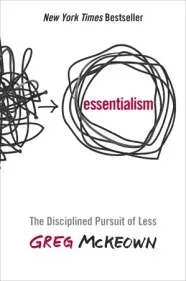
Essentialism: The Disciplined Pursuit of Less
by Greg McKeown
Listen to it free. Get Essentialism on Audible with a 30-day trial — cancel anytime.
Start listening freeon AudibleNew members only · many titles are included with the membership. As an Amazon Associate, Read Stacks earns from qualifying purchases and membership trials at no extra cost to you.
What this book is, and who it's for
Greg McKeown's 2014 book is about the discipline of saying no — to projects, to meetings, to opportunities that look good in isolation but compound into a calendar that produces nothing. The argument: when everything is a priority, nothing is. McKeown's essentialist asks 'will this be the one thing I'm proud of having spent this hour on?' and then mostly says no. The book reads as a quiet permission slip for readers stuck in a culture that mistakes busyness for usefulness. Read this when your week is full but your year isn't going anywhere that matters.
McKeown's frame: doing fewer things on purpose. The discipline is refusing the trivial many in favor of the vital few — and the refusal is harder than the doing, because most aspirations expand to fill the calendar.
How to apply Essentialism in 3 steps
- 1List everything you're saying yes to
For the next week, write down every commitment you make — meetings, requests, projects, social obligations. The list is uncomfortable to read because most of it isn't aligned with what you'd say matters most.
- 2Apply the absurd-yes test
For each item, ask: is this an absurd-yes? Would I say yes to this if it didn't exist yet? If the answer is anything other than 'absolutely', it's a no. McKeown's discipline is making 'absolutely or no' the only two options for new commitments.
- 3Cancel three things this week
Pick three current commitments that fail the absurd-yes test and end them this week — cancel the recurring meeting, decline the project, leave the side group. The cancellations create the space the essential work needs. The discomfort of canceling is the discipline.
Opening
Chapters
- Chapter 1The Essentialist1.5 min
- Chapter 2Choose: The Invincible Power of Choice1.5 min
- Chapter 3Discern: The Unimportance of Practically Everything1.5 min
- Chapter 4Trade-Off: Which Problem Do I Want?1.5 min
- Chapter 5Escape: The Perks of Being Unavailable1.5 min
- Chapter 6Look: See What Really Matters1.5 min
- Chapter 7Play: Embrace the Wisdom of Your Inner Child1.5 min
- Chapter 8Sleep: Protect the Asset1.5 min
- Chapter 9Select: The Power of Extreme Criteria1.5 min
- Chapter 10Clarify: One Decision That Makes a Thousand1.5 min
- Chapter 11Dare: The Power of a Graceful “No”1.5 min
- Chapter 12Uncommit: Win Big by Cutting Your Losses1.5 min
- Chapter 13Edit: The Invisible Art2 min
- Chapter 14Limit: The Freedom of Setting Boundaries1.5 min
- Chapter 15Buffer: The Unfair Advantage1.5 min
- Chapter 16Subtract: Bring Forth More by Removing Obstacles1.5 min
- Chapter 17Progress: The Power of Small Wins1.5 min
- Chapter 18Flow: The Genius of Routine1.5 min
- Chapter 19Focus: What’s Important Now?1.5 min
- Chapter 20BE: The Essentialist Life2 min
Closing & reference
How to read this book. Each chapter is a ~30-second summary — the core insight, no filler. Open the chapters that grab you. If the book resonates, hear the full audiobook free with an Audible trial or buy the edition on Amazon (links below, affiliate-disclosed).
Essentialism pairs well with
A single book is an argument. A stack is a curriculum. Essentialism appears in 3 curated reading paths — each pairs it with other books that sharpen its ideas, in a suggested reading order.
- 8 booksBuild better habitsEight books on how behaviour actually changes — and what to do when motivation runs out.
- 9 booksFind meaningNine books on what makes a life feel like it counted — read in the order that builds the argument.
- 4 booksWin the long gameFour books on the one mechanic that wins every domain that matters — and why most people quit before it kicks in.
More books like Essentialism
The other books in the curated reading paths Essentialism belongs to. Each one sharpens, extends, or counter-argues something Essentialism establishes — the compound is the reason these books sit together in a stack.
- Build better habitsThe 7 Habits of Highly Effective PeopleStephen R. Covey
- Build better habitsThe Power of HabitCharles Duhigg
- Build better habitsAtomic HabitsJames Clear
- Build better habitsDeep WorkCal Newport
- Build better habitsGritAngela Duckworth
- Build better habitsSo Good They Can't Ignore YouCal Newport
- Build better habitsPeakAnders Ericsson & Robert Pool
- Find meaningMeditationsMarcus Aurelius
Frequently asked questions
What is Essentialism about?+
Greg McKeown's 2014 book is about the discipline of saying no — to projects, to meetings, to opportunities that look good in isolation but compound into a calendar that produces nothing.
How long does it take to read Essentialism?+
The full Essentialism typically takes 4-6 hours to read cover-to-cover. The Read Stacks chapter summaries cover the same ideas in ~35.5 minutes total (22 chapters at ~30 seconds each).
Who is Essentialism for?+
Essentialism is for anyone trying to change how they spend their attention, energy, or time. No specific background required — the ideas apply to personal and professional life equally.
What are the key ideas in Essentialism?+
The book covers The Essentialist, Choose: The Invincible Power of Choice, Discern: The Unimportance of Practically Everything, Trade-Off: Which Problem Do I Want? and Escape: The Perks of Being Unavailable. Each chapter has a free summary on Read Stacks (~30 seconds each).
Is Essentialism worth reading?+
If you're interested in focused work and attention management, Essentialism is widely considered essential. The Read Stacks chapter summaries help you decide — read the free first chapter, then buy the full book on Amazon if the argument resonates.
Books like Essentialism
If Essentialism resonated, these non-fiction books pick up the same threads.
From Read Stacks · Learn
How to get more out of this book
Two short essays on the meta-skill — what chapter summaries actually preserve, and the six retention techniques that decide whether what you read here is still useful six months from now.
- Are book summaries actually useful, or am I just cheating?
Chapter summaries are a navigation tool, not a substitute. Used right, they help you read more books fully — by helping you avoid the wrong ones. Used wrong, they're a comfort blanket that lets you feel like you're reading without engaging with the material.
6 min read
- I read a lot of books but can't remember anything. What works?
Forgetting most of what you read is normal, not a personal failing — your brain wasn't designed to retain prose at the rate modern readers consume it. The practices that DO work share one thing: they force you to USE the material instead of just consuming it. Six specific techniques, each tested across decades.
7 min read
Appears in these topics
Essentialism is part of 3 curated reading lists — each a “best books on X” cluster with a synthesis on how the books fit together.