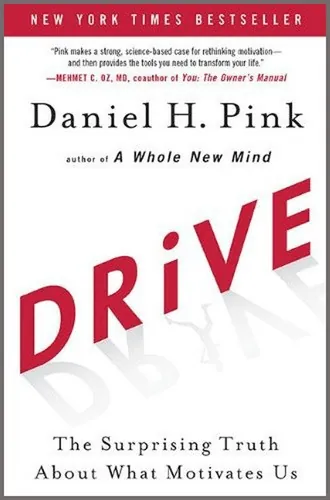
Drive: The Surprising Truth About What Motivates Us
Listen to it free. Get Drive on Audible with a free trial for eligible new members — cancel anytime.
Start listening freeon AudibleNew members only · many titles are included with the membership. As an Amazon Associate, Read Stacks earns from qualifying purchases and membership trials at no extra cost to you.
What this book is, and who it's for
Daniel Pink's 2009 book argues that the carrot-and-stick model of motivation — the one most workplaces still run on — is fundamentally mismatched to the kind of work the modern economy actually rewards. Drawing on five decades of behavioral-science research, Pink makes the case for Motivation 3.0: not external rewards, but three intrinsic drives — autonomy (control over your work), mastery (the urge to keep getting better), and purpose (connection to something larger than self-interest). The book is structured in two halves: the science of why extrinsic rewards backfire on creative work, then a practical toolkit for individuals, organizations, parents, and teachers who want to design conditions where intrinsic motivation can actually operate. Read this when you've noticed that working harder for the same reward stops producing better work.
The three intrinsic motivators Pink documents replacing the carrot-and-stick model of human performance. Each is necessary; together they explain sustained high-quality work across domains where extrinsic rewards reliably fail.
How to apply Drive in 3 steps
- 1Audit your work for the three intrinsics
For the projects you do for income or duty, score each on: how much autonomy do you have? How much mastery is the work building? How much purpose does it connect to? Low scores across all three predict burnout regardless of compensation.
- 2Negotiate for autonomy first
In any role you choose to stay in, the highest-leverage upgrade is usually more autonomy (when you work, how you work, what you work on). Money is downstream of autonomy in most knowledge work; renegotiating the first often makes the second renegotiation easier.
- 3Pick projects that build career capital
Cal Newport's frame: pursue work that builds rare and valuable skills, not work that feels meaningful in the moment. Pink's mastery dimension predicts which side projects compound into career-capital that buys autonomy and purpose later.
Chapters
- Chapter 1The Rise and Fall of Motivation 2.01.5 min
- Chapter 2Seven Reasons Carrots and Sticks Don't Work2 min
- Chapter 3Type I and Type X2 min
- Chapter 4Autonomy2 min
- Chapter 5Mastery2 min
- Chapter 6Purpose2 min
- Chapter 7The Type I Toolkit for Individuals2 min
- Chapter 8The Type I Toolkit for Organizations1.5 min
- Chapter 9The Type I Toolkit for Parents and Teachers2 min
How to read this book. Each chapter is a ~30-second summary — the core insight, no filler. Open the chapters that grab you. If the book resonates, hear the full audiobook free with an Audible trial or buy the edition on Amazon (links below, affiliate-disclosed).
Drive pairs well with
A single book is an argument. A stack is a curriculum. Drive appears in 2 curated reading paths — each pairs it with other books that sharpen its ideas, in a suggested reading order.
- 9 booksThink clearlyNine books on how minds actually decide — and how to override the wiring when it matters.
- 4 booksLead with growthFour books on the engine that distinguishes operators who improve from those who repeat — psychology, motivation, habits of effectiveness, and the discipline of testing.
More books like Drive
The other books in the curated reading paths Drive belongs to. Each one sharpens, extends, or counter-argues something Drive establishes — the compound is the reason these books sit together in a stack.
- Think clearlyThinking, Fast and SlowDaniel Kahneman
- Think clearlyPrinciplesRay Dalio
- Think clearlyOutliersMalcolm Gladwell
- Think clearlyMindsetCarol S. Dweck
- Think clearlyQuietSusan Cain
- Think clearlyThe Psychology of MoneyMorgan Housel
- Think clearlyRangeDavid Epstein
- Think clearlyPredictably IrrationalDan Ariely
Frequently asked questions
What is Drive about?+
Daniel Pink's 2009 book argues that the carrot-and-stick model of motivation — the one most workplaces still run on — is fundamentally mismatched to the kind of work the modern economy actually rewards.
How long does it take to read Drive?+
The full Drive typically takes 4-6 hours to read cover-to-cover. The Read Stacks chapter summaries cover the same ideas in ~16 minutes total (9 chapters at ~30 seconds each).
Who is Drive for?+
Drive is widely regarded as essential reading in its field. The Read Stacks summary is the fastest way to decide if the full book is worth your time before committing to it.
What are the key ideas in Drive?+
The book covers The Rise and Fall of Motivation 2.0, Seven Reasons Carrots and Sticks Don't Work, Type I and Type X, Autonomy and Mastery. Each chapter has a free summary on Read Stacks (~30 seconds each).
Is Drive worth reading?+
If you're interested in the ideas in Drive, Drive is widely considered essential. The Read Stacks chapter summaries help you decide — read the free first chapter, then buy the full book on Amazon if the argument resonates.
Books like Drive
If Drive resonated, these non-fiction books pick up the same threads.
From Read Stacks · Learn
How to get more out of this book
Three short guides: how to take notes on a non-fiction book, how to summarise a chapter in your own words, and the retention techniques that decide whether what you read here is still useful six months from now.
- How do I take notes on a non-fiction book?
Decide what the notes are for, read a full section before writing, and use the same short layout for every chapter: claim, reasons, evidence, terms and your own response, all in your own words with page numbers. Turn each note into questions for review, and finish with a one-page summary of the whole book.
5 min read
- How do I summarise a non-fiction chapter?
Read the chapter's opening and closing pages first, write its main claim as one sentence, list the two to four reasons the author gives and the best piece of evidence, then close the book and write a short paragraph from memory. Check it against the text and add one clearly labelled line of your own.
5 min read
- I read a lot of books but can't remember anything. What works?
Forgetting most of what you read is normal, not a personal failing — your brain wasn't designed to retain prose at the rate modern readers consume it. The practices that DO work share one thing: they force you to USE the material instead of just consuming it. Six specific techniques, each tested across decades.
7 min read
Appears in these topics
Drive is part of 2 curated reading lists — each a “best books on X” cluster with a synthesis on how the books fit together.