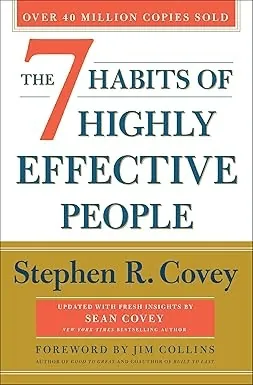
The 7 Habits of Highly Effective People
Listen to it free. Get The 7 Habits of Highly Effective People on Audible with a free trial for eligible new members — cancel anytime.
Start listening freeon AudibleNew members only · many titles are included with the membership. As an Amazon Associate, Read Stacks earns from qualifying purchases and membership trials at no extra cost to you.
What this book is, and who it's for
Stephen R. Covey's 1989 book remains the most widely-read framework for personal effectiveness ever published — and after thirty-five years, the seven habits still hold up because they're descriptions of underlying character rather than techniques. The structure moves inside-out: private victory (proactivity, ends-first, priorities) before public victory (Win/Win, listening-first, synergy) before renewal (sharpen the saw). Skipping ahead to interpersonal effectiveness without the inner work produces technique without integrity — which is exactly the personality-ethic problem Covey opens the book by naming. Read this as the foundation under almost every modern productivity book, then return to it annually for the audit it asks for.
Covey's inside-out sequence: personal effectiveness (habits 1-3 — proactivity, ends-first, priorities) precedes interpersonal effectiveness (habits 4-6 — Win/Win, listen-first, synergy), with continuous renewal (habit 7) as the foundation.
How to apply The 7 Habits in 3 steps
- 1Begin with the end in mind
Write your own funeral eulogy as you'd want it delivered. What did you stand for? What did your work contribute? What relationships defined your life? The exercise produces the personal mission statement everything else organizes around.
- 2Put first things first
Each Sunday, identify the 3 most-important things you'll do in the coming week — the things aligned with the eulogy, not the things shouting loudest. Calendar them before the urgent-not-important demands arrive. Covey's quadrant II discipline.
- 3Sharpen the saw weekly
Allocate weekly time to renewal in four dimensions: physical (exercise), mental (reading), emotional (relationships), spiritual (whatever produces meaning for you). The renewal is what makes the other six habits sustainable across decades.
Chapters
- Chapter 1Paradigms and Principles2 min
- Chapter 2Habit 1: Be Proactive2 min
- Chapter 3Habit 2: Begin with the End in Mind1.5 min
- Chapter 4Habit 3: Put First Things First1.5 min
- Chapter 5Habit 4: Think Win/Win1.5 min
- Chapter 6Habit 5: Seek First to Understand1.5 min
- Chapter 7Habit 6: Synergize1.5 min
- Chapter 8Habit 7: Sharpen the Saw1.5 min
- Chapter 9Inside-Out Again1.5 min
- Chapter 10Renewal and Continued Practice1.5 min
How to read this book. Each chapter is a ~30-second summary — the core insight, no filler. Open the chapters that grab you. If the book resonates, hear the full audiobook free with an Audible trial or buy the edition on Amazon (links below, affiliate-disclosed).
The 7 Habits of Highly Effective People pairs well with
A single book is an argument. A stack is a curriculum. The 7 Habits of Highly Effective People appears in 2 curated reading paths — each pairs it with other books that sharpen its ideas, in a suggested reading order.
- 8 booksBuild better habitsEight books on how behaviour actually changes — and what to do when motivation runs out.
- 4 booksLead with growthFour books on the engine that distinguishes operators who improve from those who repeat — psychology, motivation, habits of effectiveness, and the discipline of testing.
More books like The 7 Habits of Highly Effective People
The other books in the curated reading paths The 7 Habits of Highly Effective People belongs to. Each one sharpens, extends, or counter-argues something The 7 Habits of Highly Effective People establishes — the compound is the reason these books sit together in a stack.
- Build better habitsThe Power of HabitCharles Duhigg
- Build better habitsAtomic HabitsJames Clear
- Build better habitsDeep WorkCal Newport
- Build better habitsEssentialismGreg McKeown
- Build better habitsGritAngela Duckworth
- Build better habitsSo Good They Can't Ignore YouCal Newport
- Build better habitsPeakAnders Ericsson & Robert Pool
- Lead with growthMindsetCarol S. Dweck
Frequently asked questions
What is The 7 Habits of Highly Effective People about?+
Stephen R.
How long does it take to read The 7 Habits of Highly Effective People?+
The full The 7 Habits of Highly Effective People typically takes 4-6 hours to read cover-to-cover. The Read Stacks chapter summaries cover the same ideas in ~17 minutes total (10 chapters at ~30 seconds each).
Who is The 7 Habits of Highly Effective People for?+
The 7 Habits of Highly Effective People is for anyone trying to change how they spend their attention, energy, or time. No specific background required — the ideas apply to personal and professional life equally.
What are the key ideas in The 7 Habits of Highly Effective People?+
The book covers Paradigms and Principles, Habit 1: Be Proactive, Habit 2: Begin with the End in Mind, Habit 3: Put First Things First and Habit 4: Think Win/Win. Each chapter has a free summary on Read Stacks (~30 seconds each).
Is The 7 Habits of Highly Effective People worth reading?+
If you're interested in behavior change and habit formation, The 7 Habits of Highly Effective People is widely considered essential. The Read Stacks chapter summaries help you decide — read the free first chapter, then buy the full book on Amazon if the argument resonates.
Books like The 7 Habits of Highly Effective People
If The 7 Habits of Highly Effective People resonated, these non-fiction books pick up the same threads.
From Read Stacks · Learn
How to get more out of this book
Three short guides: how to take notes on a non-fiction book, how to summarise a chapter in your own words, and the retention techniques that decide whether what you read here is still useful six months from now.
- How do I take notes on a non-fiction book?
Decide what the notes are for, read a full section before writing, and use the same short layout for every chapter: claim, reasons, evidence, terms and your own response, all in your own words with page numbers. Turn each note into questions for review, and finish with a one-page summary of the whole book.
5 min read
- How do I summarise a non-fiction chapter?
Read the chapter's opening and closing pages first, write its main claim as one sentence, list the two to four reasons the author gives and the best piece of evidence, then close the book and write a short paragraph from memory. Check it against the text and add one clearly labelled line of your own.
5 min read
- I read a lot of books but can't remember anything. What works?
Forgetting most of what you read is normal, not a personal failing — your brain wasn't designed to retain prose at the rate modern readers consume it. The practices that DO work share one thing: they force you to USE the material instead of just consuming it. Six specific techniques, each tested across decades.
7 min read
Appears in these topics
The 7 Habits of Highly Effective People is part of 2 curated reading lists — each a “best books on X” cluster with a synthesis on how the books fit together.