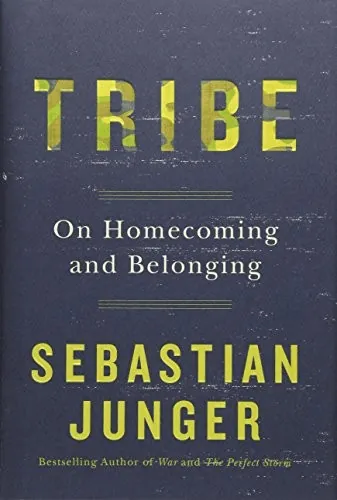
Tribe: On Homecoming and Belonging
Listen to it free. Get Tribe on Audible with a free trial for eligible new members — cancel anytime.
Start listening freeon AudibleNew members only · many titles are included with the membership. As an Amazon Associate, Read Stacks earns from qualifying purchases and membership trials at no extra cost to you.
What this book is, and who it's for
Sebastian Junger's 2016 book is a short, dense meditation on a paradox: modern affluent societies are wealthier, safer, and longer-lived than any in human history, and they are simultaneously producing rates of depression, loneliness, and suicide that ancestral tribal societies did not. Junger's argument, drawing on military veterans (his original beat), historical captivity narratives, and disaster psychology, is that humans evolved within small, interdependent groups whose tribal conditions — daily proximity, shared purpose, mutual reliance, a clearly-needed role — modern individualistic societies systematically suppress. The book is not a romanticization of war or catastrophe; it is a careful argument that the conditions humans need most are not material, and that the modern lifestyle has eliminated them as a side effect of producing the material wealth we counted as progress. Read this if you've ever felt the unease of a comfortable life and wondered what was missing.
The small-group, mutually-reliant, shared-purpose conditions humans evolved within and that modern affluent societies have systematically suppressed as a side effect of producing material wealth — Junger's diagnosis of the loneliness epidemic.
How to apply Tribe in 3 steps
- 1Audit your group conditions
Do you currently belong to a small group (5-15 people) where: members are mutually reliant, work toward shared purpose, and would mobilize for each other in crisis? For most modern affluent adults, the answer is no, and that absence is the unease the book names.
- 2Engineer one tribal condition this month
Pick one: a weekly meal with the same 6-10 people, a project where you mutually rely on a small group, a regular service commitment with a tight team. Junger's research is that consistency over months matters more than intensity in one moment.
- 3Tolerate the friction of tight groups
Tight groups have friction precisely because the stakes are real. Modern individualism avoids the friction by avoiding the group. The exchange is unease. Junger's argument: the friction is the price of the belonging humans actually need. Stay through the friction rather than escaping it.
Chapters
How to read this book. Each chapter is a ~30-second summary — the core insight, no filler. Open the chapters that grab you. If the book resonates, hear the full audiobook free with an Audible trial or buy the edition on Amazon (links below, affiliate-disclosed).
Tribe pairs well with
A single book is an argument. A stack is a curriculum. Tribe appears in this curated reading path — each pairs it with other books that sharpen its ideas, in a suggested reading order.
More books like Tribe
The other books in the curated reading paths Tribe belongs to. Each one sharpens, extends, or counter-argues something Tribe establishes — the compound is the reason these books sit together in a stack.
- Find meaningMeditationsMarcus Aurelius
- Find meaningThe Obstacle Is the WayRyan Holiday
- Find meaningMan’s Search for MeaningViktor E. Frankl
- Find meaningThe Courage to Be DislikedIchiro Kishimi & Fumitake Koga
- Find meaningSapiensYuval Noah Harari
- Find meaningHomo DeusYuval Noah Harari
- Find meaningEssentialismGreg McKeown
- Find meaningEgo Is the EnemyRyan Holiday
Frequently asked questions
What is Tribe about?+
Sebastian Junger's 2016 book is a short, dense meditation on a paradox: modern affluent societies are wealthier, safer, and longer-lived than any in human history, and they are simultaneously producing rates of depression, loneliness, and suicide that ancestral tribal societies did not.
How long does it take to read Tribe?+
The full Tribe typically takes 4-6 hours to read cover-to-cover. The Read Stacks chapter summaries cover the same ideas in ~7 minutes total (4 chapters at ~30 seconds each).
Who is Tribe for?+
Tribe is for readers curious about why people think and decide the way they do. Useful for designers, marketers, negotiators, and anyone making decisions with imperfect information.
What are the key ideas in Tribe?+
The book covers The Men and the Dogs, War Makes You an Animal, In Bitter Safety I Awake and Calling Home from Mars. Each chapter has a free summary on Read Stacks (~30 seconds each).
Is Tribe worth reading?+
If you're interested in the ideas in Tribe, Tribe is widely considered essential. The Read Stacks chapter summaries help you decide — read the free first chapter, then buy the full book on Amazon if the argument resonates.
Books like Tribe
If Tribe resonated, these non-fiction books pick up the same threads.

From Read Stacks · Learn
How to get more out of this book
Three short guides: how to take notes on a non-fiction book, how to summarise a chapter in your own words, and the retention techniques that decide whether what you read here is still useful six months from now.
- How do I take notes on a non-fiction book?
Decide what the notes are for, read a full section before writing, and use the same short layout for every chapter: claim, reasons, evidence, terms and your own response, all in your own words with page numbers. Turn each note into questions for review, and finish with a one-page summary of the whole book.
5 min read
- How do I summarise a non-fiction chapter?
Read the chapter's opening and closing pages first, write its main claim as one sentence, list the two to four reasons the author gives and the best piece of evidence, then close the book and write a short paragraph from memory. Check it against the text and add one clearly labelled line of your own.
5 min read
- I read a lot of books but can't remember anything. What works?
Forgetting most of what you read is normal, not a personal failing — your brain wasn't designed to retain prose at the rate modern readers consume it. The practices that DO work share one thing: they force you to USE the material instead of just consuming it. Six specific techniques, each tested across decades.
7 min read
Appears in these topics
Tribe is part of 2 curated reading lists — each a “best books on X” cluster with a synthesis on how the books fit together.