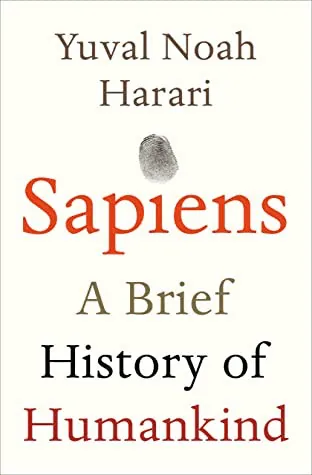
Sapiens: A Brief History of Humankind
Listen to it free. Get Sapiens on Audible with a 30-day trial — cancel anytime.
Start listening freeon AudibleNew members only · many titles are included with the membership. As an Amazon Associate, Read Stacks earns from qualifying purchases and membership trials at no extra cost to you.
What this book is, and who it's for
Yuval Noah Harari's 2011 sweeping history of Homo sapiens from 70,000 years ago to roughly today rests on one unifying claim: humans dominated the planet by inventing shared fictions. Money, religion, nation, corporation, human rights — all are imagined orders that exist because enough humans agree to act as if they do. The argument is uncomfortable because it doesn't deny these fictions are useful, just that they are fictions. Read this for the long-arc context that almost every other non-fiction book on this list assumes but rarely names. Sapiens is the meta-text underneath the personal-development library.
The collective myths — religion, money, nation, corporation — that allow Homo sapiens to cooperate flexibly in groups larger than evolutionary biology can otherwise sustain. Harari's central explanatory mechanism for civilization.
How to apply Sapiens in 3 steps
- 1Name the shared fiction
Pick one institution you take for granted (money, your company, your country). Write down what would happen to it if everyone simultaneously stopped believing in it. The exercise reveals which structures around you depend on collective belief rather than on physical reality.
- 2Audit your own shared fictions
What stories do you operate inside daily — about career success, what counts as a good life, what your work is for? Most of these are inherited from your specific time and culture, not chosen. Listing them is the first step to choosing which to keep.
- 3Decide which fictions serve you
Some shared fictions (rule of law, scientific method, basic human rights) are useful to keep believing in. Some (specific status games, manufactured desires, inherited career scripts) you can deliberately disinvest from. The audit is yours to make; the disinvestment is what changes the next decade.
Chapters
- Chapter 1An Animal of No Significance2 min
- Chapter 2The Tree of Knowledge1.5 min
- Chapter 3A Day in the Life of Adam and Eve2 min
- Chapter 4The Flood2 min
- Chapter 5History’s Biggest Fraud1.5 min
- Chapter 6Building Pyramids1.5 min
- Chapter 7Memory Overload2 min
- Chapter 8There Is No Justice in History1.5 min
- Chapter 9The Arrow of History1.5 min
- Chapter 10The Scent of Money1.5 min
- Chapter 11Imperial Visions1.5 min
- Chapter 12The Law of Religion1.5 min
- Chapter 13The Secret of Success1.5 min
- Chapter 14The Discovery of Ignorance1.5 min
- Chapter 15The Marriage of Science and Empire2 min
- Chapter 16The Capitalist Creed1.5 min
- Chapter 17The Wheels of Industry1.5 min
- Chapter 18A Permanent Revolution1.5 min
- Chapter 19And They Lived Happily Ever After1.5 min
- Chapter 20The End of Homo Sapiens1.5 min
Closing & reference
How to read this book. Each chapter is a ~30-second summary — the core insight, no filler. Open the chapters that grab you. If the book resonates, hear the full audiobook free with an Audible trial or buy the edition on Amazon (links below, affiliate-disclosed).
Sapiens pairs well with
A single book is an argument. A stack is a curriculum. Sapiens appears in this curated reading path — each pairs it with other books that sharpen its ideas, in a suggested reading order.
More books like Sapiens
The other books in the curated reading paths Sapiens belongs to. Each one sharpens, extends, or counter-argues something Sapiens establishes — the compound is the reason these books sit together in a stack.
- Find meaningMeditationsMarcus Aurelius
- Find meaningThe Obstacle Is the WayRyan Holiday
- Find meaningMan’s Search for MeaningViktor E. Frankl
- Find meaningThe Courage to Be DislikedIchiro Kishimi & Fumitake Koga
- Find meaningHomo DeusYuval Noah Harari
- Find meaningEssentialismGreg McKeown
- Find meaningTribeSebastian Junger
- Find meaningEgo Is the EnemyRyan Holiday
Frequently asked questions
What is Sapiens about?+
Yuval Noah Harari's 2011 sweeping history of Homo sapiens from 70,000 years ago to roughly today rests on one unifying claim: humans dominated the planet by inventing shared fictions.
How long does it take to read Sapiens?+
The full Sapiens typically takes 4-6 hours to read cover-to-cover. The Read Stacks chapter summaries cover the same ideas in ~36 minutes total (21 chapters at ~30 seconds each).
Who is Sapiens for?+
Sapiens is widely regarded as essential reading in its field. The Read Stacks summary is the fastest way to decide if the full book is worth your time before committing to it.
What are the key ideas in Sapiens?+
The book covers An Animal of No Significance, The Tree of Knowledge, A Day in the Life of Adam and Eve, The Flood and History’s Biggest Fraud. Each chapter has a free summary on Read Stacks (~30 seconds each).
Is Sapiens worth reading?+
If you're interested in human history and the long arc of cognition, Sapiens is widely considered essential. The Read Stacks chapter summaries help you decide — read the free first chapter, then buy the full book on Amazon if the argument resonates.
Books like Sapiens
If Sapiens resonated, these non-fiction books pick up the same threads.
From Read Stacks · Learn
How to get more out of this book
Two short essays on the meta-skill — what chapter summaries actually preserve, and the six retention techniques that decide whether what you read here is still useful six months from now.
- Are book summaries actually useful, or am I just cheating?
Chapter summaries are a navigation tool, not a substitute. Used right, they help you read more books fully — by helping you avoid the wrong ones. Used wrong, they're a comfort blanket that lets you feel like you're reading without engaging with the material.
6 min read
- I read a lot of books but can't remember anything. What works?
Forgetting most of what you read is normal, not a personal failing — your brain wasn't designed to retain prose at the rate modern readers consume it. The practices that DO work share one thing: they force you to USE the material instead of just consuming it. Six specific techniques, each tested across decades.
7 min read
Appears in these topics
Sapiens is part of this curated reading list — each a “best books on X” cluster with a synthesis on how the books fit together.