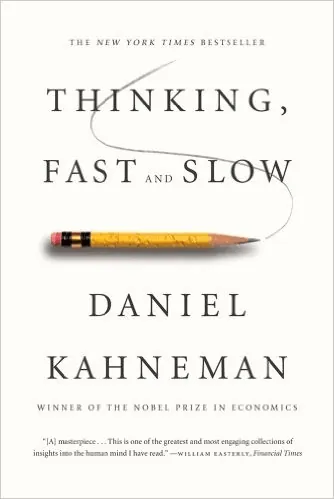
Thinking, Fast and Slow
Listen to it free. Get Thinking, Fast and Slow on Audible with a 30-day trial — cancel anytime.
Start listening freeon AudibleNew members only · many titles are included with the membership. As an Amazon Associate, Read Stacks earns from qualifying purchases and membership trials at no extra cost to you.
What this book is, and who it's for
Daniel Kahneman's 2011 career-summary volume distills four decades of research that won him the Nobel Prize in Economics — research that almost single-handedly created the field of behavioral economics. The two-system frame (System 1: fast, automatic, error-prone; System 2: slow, effortful, lazy) is now lingua franca for talking about decisions. The book is long and dense in spots but rewards the patience: every cognitive bias popularized in the last decade is in here, with the experiment that demonstrated it. Read this once and you'll recognize your own thinking errors in real time — which is the first step toward not making them.
The two parallel cognitive processes — fast/automatic vs slow/deliberate — that produce all human judgment. Kahneman's organizing frame for the catalog of cognitive biases his research has documented.
How to apply Thinking Fast and Slow in 3 steps
- 1Name your System 1 patterns
Pick the three decisions you've made recently that you'd describe as automatic — purchasing patterns, who you trust on first meeting, what you skim past in news. These are System 1 outputs. Naming them is the precondition for ever questioning them.
- 2Pre-commit to System 2 on high-stakes calls
For decisions above a threshold you set ($1,000? six-month commitment?), require yourself to write down the reasoning before deciding. Sleep on it overnight when feasible. The friction is the System 2 forcing function.
- 3Externalize your principles
For decisions you'll face repeatedly (investment moves, hiring, customer choices), write the rules in advance when calm. Then follow them under pressure rather than re-deciding. Dalio's Principles is the operationalization of this Kahneman insight.
Chapters
- Chapter 1The Characters of the Story2 min
- Chapter 2Attention and Effort2 min
- Chapter 3The Lazy Controller2 min
- Chapter 4The Associative Machine2 min
- Chapter 5Cognitive Ease2 min
- Chapter 6Norms, Surprises, and Causes2 min
- Chapter 7A Machine for Jumping to Conclusions2 min
- Chapter 8How Judgments Happen2 min
- Chapter 9Answering an Easier Question2 min
- Chapter 10The Law of Small Numbers2 min
- Chapter 11Anchors2 min
- Chapter 12The Science of Availability2 min
- Chapter 13Availability, Emotion, and Risk2 min
- Chapter 14Tom W’s Specialty2 min
- Chapter 15Linda: Less is More2 min
- Chapter 16Causes Trump Statistics2 min
- Chapter 17Regression to the Mean2 min
- Chapter 18Taming Intuitive Predictions2 min
- Chapter 19The Illusion of Understanding2 min
- Chapter 20The Illusion of Validity2 min
- Chapter 21Intuitions Vs. Formulas2 min
- Chapter 22Expert Intuition: When Can We Trust It?2 min
- Chapter 23The Outside View2 min
- Chapter 24The Engine of Capitalism2 min
- Chapter 25Bernoulli’s Errors2 min
- Chapter 26Prospect Theory2 min
- Chapter 27The Endowment Effect2 min
- Chapter 28Bad Events2 min
- Chapter 29The Fourfold Pattern2 min
- Chapter 30Rare Events2 min
- Chapter 31Risk Policies2 min
- Chapter 32Keeping Score2 min
- Chapter 33Reversals2 min
- Chapter 34Frames and Reality2 min
- Chapter 35Two Selves2 min
- Chapter 36Life as a Story2 min
- Chapter 37Experienced Well-Being2 min
- Chapter 38Thinking About Life2 min
How to read this book. Each chapter is a ~30-second summary — the core insight, no filler. Open the chapters that grab you. If the book resonates, hear the full audiobook free with an Audible trial or buy the edition on Amazon (links below, affiliate-disclosed).
Thinking, Fast and Slow pairs well with
A single book is an argument. A stack is a curriculum. Thinking, Fast and Slow appears in this curated reading path — each pairs it with other books that sharpen its ideas, in a suggested reading order.
More books like Thinking, Fast and Slow
The other books in the curated reading paths Thinking, Fast and Slow belongs to. Each one sharpens, extends, or counter-argues something Thinking, Fast and Slow establishes — the compound is the reason these books sit together in a stack.
Frequently asked questions
What is Thinking, Fast and Slow about?+
Daniel Kahneman's 2011 career-summary volume distills four decades of research that won him the Nobel Prize in Economics — research that almost single-handedly created the field of behavioral economics.
How long does it take to read Thinking, Fast and Slow?+
The full Thinking, Fast and Slow typically takes 4-6 hours to read cover-to-cover. The Read Stacks chapter summaries cover the same ideas in ~75.5 minutes total (38 chapters at ~30 seconds each).
Who is Thinking, Fast and Slow for?+
Thinking, Fast and Slow is for readers curious about why people think and decide the way they do. Useful for designers, marketers, negotiators, and anyone making decisions with imperfect information.
What are the key ideas in Thinking, Fast and Slow?+
The book covers The Characters of the Story, Attention and Effort, The Lazy Controller, The Associative Machine and Cognitive Ease. Each chapter has a free summary on Read Stacks (~30 seconds each).
Is Thinking, Fast and Slow worth reading?+
If you're interested in cognitive bias and clearer decision-making, Thinking, Fast and Slow is widely considered essential. The Read Stacks chapter summaries help you decide — read the free first chapter, then buy the full book on Amazon if the argument resonates.
Books like Thinking, Fast and Slow
If Thinking, Fast and Slow resonated, these non-fiction books pick up the same threads.
From Read Stacks · Learn
How to get more out of this book
Two short essays on the meta-skill — what chapter summaries actually preserve, and the six retention techniques that decide whether what you read here is still useful six months from now.
- Are book summaries actually useful, or am I just cheating?
Chapter summaries are a navigation tool, not a substitute. Used right, they help you read more books fully — by helping you avoid the wrong ones. Used wrong, they're a comfort blanket that lets you feel like you're reading without engaging with the material.
6 min read
- I read a lot of books but can't remember anything. What works?
Forgetting most of what you read is normal, not a personal failing — your brain wasn't designed to retain prose at the rate modern readers consume it. The practices that DO work share one thing: they force you to USE the material instead of just consuming it. Six specific techniques, each tested across decades.
7 min read
Appears in these topics
Thinking, Fast and Slow is part of 3 curated reading lists — each a “best books on X” cluster with a synthesis on how the books fit together.