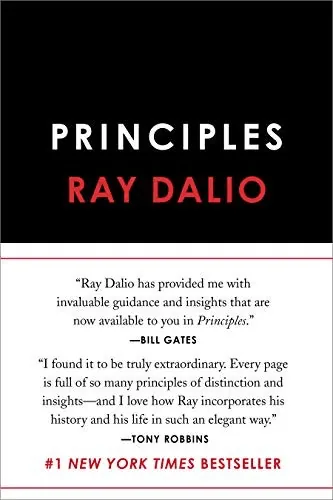
Principles: Life and Work
by Ray Dalio
Listen to it free. Get Principles on Audible with a 30-day trial — cancel anytime.
Start listening freeon AudibleNew members only · many titles are included with the membership. As an Amazon Associate, Read Stacks earns from qualifying purchases and membership trials at no extra cost to you.
What this book is, and who it's for
Ray Dalio, founder of Bridgewater Associates (the world's largest hedge fund), spent decades writing down the principles that produced his best decisions and codifying them into a system anyone in his firm could use to debate, refine, and override individual judgement. The book is two halves: a personal memoir of how Dalio learned to systematize, and the encyclopedia of life-and-work principles themselves. The deeper argument is that 'meritocracy' is only real when you've written down what counts as merit — and that radically transparent disagreement is the engine of any organization that wants to keep improving. Read this if you've noticed your decisions are inconsistent across contexts.
Dalio's organizational practice of recording every meeting and making every decision principle-explicit, so the organization learns from outcomes rather than recycling errors. The mechanism is uncomfortable; the compound is durable.
How to apply Principles in 3 steps
- 1Write down your principles
For decisions you face repeatedly (hiring, prioritization, conflict resolution, investment), write down the rule you'd want to follow when calm. Dalio's central practice is making the rules explicit so future-you can follow them under pressure when intuition isn't reliable.
- 2Pressure-test them against past decisions
Take 3-5 past decisions and apply your written principles. Did they correctly predict the better choice? When they didn't, was the principle wrong or was reality genuinely different? The iteration is how the principles improve.
- 3Make principles meeting-explicit
In any team or partnership you're in, propose making decision-principles explicit and reviewable. Dalio's radical transparency: organizations that codify their decision logic learn faster than ones that re-decide everything case-by-case. The meeting cost is low; the learning compound is high.
Opening
Chapters
- Chapter 1My call to adventure, 1949-19671.5 min
- Chapter 2Crossing the threshold, 1967-19791.5 min
- Chapter 3My abyss, 1979-19821.5 min
- Chapter 4My road of trials, 1983-19941.5 min
- Chapter 5The ultimate boon, 1995-20101.5 min
- Chapter 6Returning the boon, 2011-20151.5 min
- Chapter 7My last year and my greatest challenge, 2016-20172 min
- Chapter 8Looking back from a higher level1.5 min
- Chapter 9Embrace reality and deal with it1.5 min
- Chapter 10Use the 5-step process to get what you want out of life1.5 min
- Chapter 11Be radically open-minded2 min
- Chapter 12Understand that people are wired very differently1.5 min
- Chapter 13Learn how to make decisions effectively1.5 min
- Chapter 14Life principles: putting it all together1.5 min
- Chapter 15Trust in radical truth and radical transparency1.5 min
- Chapter 16Cultivate meaningful work and meaningful relationships1.5 min
- Chapter 17Create a culture in which it is okay to make mistakes and unacceptable not to learn from them1.5 min
- Chapter 18Get and stay in sync2 min
- Chapter 19Believability weight your decision making1.5 min
- Chapter 20Recognize how to get beyond disagreements2 min
- Chapter 21Remember that the WHO is more important than the WHAT1.5 min
- Chapter 22Hire right, because the penalties for hiring wrong are huge1.5 min
- Chapter 23Constantly train, test, evaluate, and sort people1.5 min
- Chapter 24Manage as someone operating a machine to achieve a goal1.5 min
- Chapter 25Perceive and don’t tolerate problems1.5 min
- Chapter 26Diagnose problems to get at their roots2 min
- Chapter 27Design improvements to your machine to get around your problems2 min
- Chapter 28Do what you set out to do1.5 min
- Chapter 29Use tools and protocols to shape how work is done1.5 min
- Chapter 30And for heaven’s sake, don’t overlook governance!1.5 min
- Chapter 31Work principles: putting it all together2 min
Closing & reference
How to read this book. Each chapter is a ~30-second summary — the core insight, no filler. Open the chapters that grab you. If the book resonates, hear the full audiobook free with an Audible trial or buy the edition on Amazon (links below, affiliate-disclosed).
Principles pairs well with
A single book is an argument. A stack is a curriculum. Principles appears in this curated reading path — each pairs it with other books that sharpen its ideas, in a suggested reading order.
More books like Principles
The other books in the curated reading paths Principles belongs to. Each one sharpens, extends, or counter-argues something Principles establishes — the compound is the reason these books sit together in a stack.
- Think clearlyThinking, Fast and SlowDaniel Kahneman
- Think clearlyOutliersMalcolm Gladwell
- Think clearlyMindsetCarol S. Dweck
- Think clearlyDriveDaniel H. Pink
- Think clearlyQuietSusan Cain
- Think clearlyThe Psychology of MoneyMorgan Housel
- Think clearlyRangeDavid Epstein
- Think clearlyPredictably IrrationalDan Ariely
Frequently asked questions
What is Principles about?+
Ray Dalio, founder of Bridgewater Associates (the world's largest hedge fund), spent decades writing down the principles that produced his best decisions and codifying them into a system anyone in his firm could use to debate, refine, and override individual judgement.
How long does it take to read Principles?+
The full Principles typically takes 4-6 hours to read cover-to-cover. The Read Stacks chapter summaries cover the same ideas in ~58 minutes total (34 chapters at ~30 seconds each).
Who is Principles for?+
Principles is written for founders, operators, and business leaders. The ideas apply across team sizes from solo to enterprise, with case examples drawn from Ray Dalio's direct experience.
What are the key ideas in Principles?+
The book covers My call to adventure, 1949-1967, Crossing the threshold, 1967-1979, My abyss, 1979-1982, My road of trials, 1983-1994 and The ultimate boon, 1995-2010. Each chapter has a free summary on Read Stacks (~30 seconds each).
Is Principles worth reading?+
If you're interested in the ideas in Principles, Principles is widely considered essential. The Read Stacks chapter summaries help you decide — read the free first chapter, then buy the full book on Amazon if the argument resonates.
Books like Principles
If Principles resonated, these non-fiction books pick up the same threads.
From Read Stacks · Learn
How to get more out of this book
Two short essays on the meta-skill — what chapter summaries actually preserve, and the six retention techniques that decide whether what you read here is still useful six months from now.
- Are book summaries actually useful, or am I just cheating?
Chapter summaries are a navigation tool, not a substitute. Used right, they help you read more books fully — by helping you avoid the wrong ones. Used wrong, they're a comfort blanket that lets you feel like you're reading without engaging with the material.
6 min read
- I read a lot of books but can't remember anything. What works?
Forgetting most of what you read is normal, not a personal failing — your brain wasn't designed to retain prose at the rate modern readers consume it. The practices that DO work share one thing: they force you to USE the material instead of just consuming it. Six specific techniques, each tested across decades.
7 min read
Appears in these topics
Principles is part of 2 curated reading lists — each a “best books on X” cluster with a synthesis on how the books fit together.