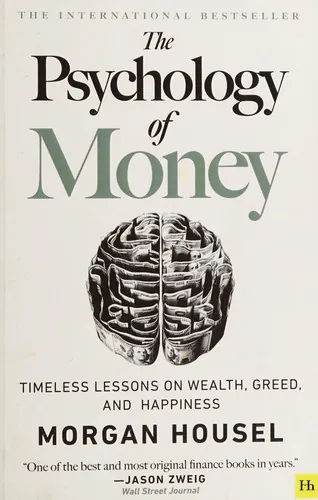
The Psychology of Money
Listen to it free. Get The Psychology of Money on Audible with a 30-day trial — cancel anytime.
Start listening freeon AudibleNew members only · many titles are included with the membership. As an Amazon Associate, Read Stacks earns from qualifying purchases and membership trials at no extra cost to you.
What this book is, and who it's for
Morgan Housel's 2020 book is the rare personal-finance book whose argument is mostly psychological. Twenty short essays make a single case: financial outcomes are determined less by intelligence and more by behavior — and behavior is determined by the stories you carry about money from childhood, peer groups, and the specific decade you happened to come of age in. Housel's framing of 'reasonable beats rational' (because reasonable strategies are the ones you actually keep) explains more about why smart people make terrible money decisions than any of the textbook risk-tolerance frameworks. Read this if your investment strategy is sound on paper but you keep deviating from it.
Housel's central distinction: financial decisions made by reasonable people you'd want to live with outperform decisions made by rational people optimizing on paper. The book is a catalog of where rationality on paper fails reality.
How to apply The Psychology of Money in 3 steps
- 1Define your enough
What income level / net worth would let you live the life you'd want without continuing to optimize for more? Write the number down. Without it, the chase has no terminus, and Housel's argument is that the chase without terminus is the cause of most financial unhappiness.
- 2Save more than you earn-rate suggests
Whatever your current saving discipline, raise it 5%. Wealth is what you don't spend, not what you earn. The compounding works on the savings rate over time; raising the rate today materially changes the trajectory by decade three.
- 3Tolerate volatility for long-horizon returns
Most retail investors destroy returns by selling during downturns. Pre-commit to your investment strategy in writing when calm, then ignore the news cycle. The reasonable strategy you follow beats the rational strategy you abandon.
Chapters
- Chapter 1No One’s Crazy2 min
- Chapter 2Luck & Risk2 min
- Chapter 3Never Enough1.5 min
- Chapter 4Confounding Compounding1.5 min
- Chapter 5Getting Wealthy vs. Staying Wealthy1.5 min
- Chapter 6Tails, You Win2 min
- Chapter 7Freedom2 min
- Chapter 8Man in the Car Paradox1.5 min
- Chapter 9Wealth is What You Don’t See1.5 min
- Chapter 10Save Money2 min
- Chapter 11Reasonable > Rational2 min
- Chapter 12Surprise!1.5 min
- Chapter 13Room for Error2 min
- Chapter 14You’ll Change2 min
- Chapter 15Nothing’s Free1.5 min
- Chapter 16You & Me1.5 min
- Chapter 17The Seduction of Pessimism2 min
- Chapter 18When You’ll Believe Anything2 min
- Chapter 19All Together Now2 min
- Chapter 20Confessions2 min
How to read this book. Each chapter is a ~30-second summary — the core insight, no filler. Open the chapters that grab you. If the book resonates, hear the full audiobook free with an Audible trial or buy the edition on Amazon (links below, affiliate-disclosed).
The Psychology of Money pairs well with
A single book is an argument. A stack is a curriculum. The Psychology of Money appears in 2 curated reading paths — each pairs it with other books that sharpen its ideas, in a suggested reading order.
More books like The Psychology of Money
The other books in the curated reading paths The Psychology of Money belongs to. Each one sharpens, extends, or counter-argues something The Psychology of Money establishes — the compound is the reason these books sit together in a stack.
Frequently asked questions
What is The Psychology of Money about?+
Morgan Housel's 2020 book is the rare personal-finance book whose argument is mostly psychological.
How long does it take to read The Psychology of Money?+
The full The Psychology of Money typically takes 4-6 hours to read cover-to-cover. The Read Stacks chapter summaries cover the same ideas in ~36 minutes total (20 chapters at ~30 seconds each).
Who is The Psychology of Money for?+
The Psychology of Money is for readers curious about why people think and decide the way they do. Useful for designers, marketers, negotiators, and anyone making decisions with imperfect information.
What are the key ideas in The Psychology of Money?+
The book covers No One’s Crazy, Luck & Risk, Never Enough, Confounding Compounding and Getting Wealthy vs. Staying Wealthy. Each chapter has a free summary on Read Stacks (~30 seconds each).
Is The Psychology of Money worth reading?+
If you're interested in wealth, investing, and financial behavior, The Psychology of Money is widely considered essential. The Read Stacks chapter summaries help you decide — read the free first chapter, then buy the full book on Amazon if the argument resonates.
Books like The Psychology of Money
If The Psychology of Money resonated, these non-fiction books pick up the same threads.
From Read Stacks · Learn
How to get more out of this book
Two short essays on the meta-skill — what chapter summaries actually preserve, and the six retention techniques that decide whether what you read here is still useful six months from now.
- Are book summaries actually useful, or am I just cheating?
Chapter summaries are a navigation tool, not a substitute. Used right, they help you read more books fully — by helping you avoid the wrong ones. Used wrong, they're a comfort blanket that lets you feel like you're reading without engaging with the material.
6 min read
- I read a lot of books but can't remember anything. What works?
Forgetting most of what you read is normal, not a personal failing — your brain wasn't designed to retain prose at the rate modern readers consume it. The practices that DO work share one thing: they force you to USE the material instead of just consuming it. Six specific techniques, each tested across decades.
7 min read
Appears in these topics
The Psychology of Money is part of 2 curated reading lists — each a “best books on X” cluster with a synthesis on how the books fit together.