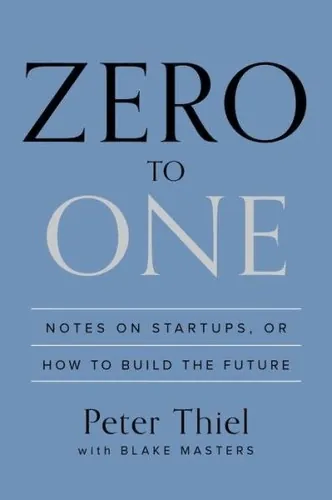
Zero to One: Notes on Startups, or How to Build the Future
Listen to it free. Get Zero to One on Audible with a free trial for eligible new members — cancel anytime.
Start listening freeon AudibleNew members only · many titles are included with the membership. As an Amazon Associate, Read Stacks earns from qualifying purchases and membership trials at no extra cost to you.
What this book is, and who it's for
Peter Thiel's 2014 book — built from his Stanford CS183 lecture notes that Blake Masters compiled — argues that real progress is vertical, not horizontal: going from zero to one (creating something that did not exist) is fundamentally different from going from one to n (copying what works). Thiel's central claim, sharpened by his career as PayPal co-founder and Founders Fund investor, is that competition is for losers and that durable wealth comes from building a monopoly on a small, defensible market and expanding outward from there. The book is also a contrarian's manifesto: it asks readers to answer the question "what important truth do very few people agree with you on?" and treats that answer as the seed of any startup worth building. Read this when you suspect the conventional wisdom of your industry is wrong but can't yet articulate why.
Vertical progress — creating something that did not exist before, distinct from one-to-N (horizontal progress: copying and scaling what works). Thiel's argument is that durable wealth comes from rare zero-to-one work, not from the more-common horizontal kind.
How to apply Zero to One in 3 steps
- 1Ask Thiel's interview question
What important truth do very few people agree with you on? The honest answer (not contrarian for its own sake; not conventionally accepted) is the seed of work worth doing. Most people fail the question because they haven't done the sustained independent thinking required to have one.
- 2Pick a small market you can monopolize
Don't aim for 1% of a huge market. Aim for >90% of a small one and expand outward. The monopoly position in a defensible niche compounds; the competitive position in a huge market is always under pressure. Identify the niche where your unfair advantage matters most.
- 3Build something that didn't exist
The zero-to-one work is creating something new, not iterating on what exists. For your next consequential project, ask: am I going zero-to-one (new), or one-to-N (copy/scale)? Both have value; the rewards and required disciplines are different. Choose deliberately.
Chapters
- Chapter 1The Challenge of the Future1.5 min
- Chapter 2Party Like It's 19991.5 min
- Chapter 3All Happy Companies Are Different2 min
- Chapter 4The Ideology of Competition2 min
- Chapter 5Last Mover Advantage2 min
- Chapter 6You Are Not a Lottery Ticket2 min
- Chapter 7Follow the Money2 min
- Chapter 8Secrets2 min
- Chapter 9Foundations2 min
- Chapter 10The Mechanics of Mafia2 min
How to read this book. Each chapter is a ~30-second summary — the core insight, no filler. Open the chapters that grab you. If the book resonates, hear the full audiobook free with an Audible trial or buy the edition on Amazon (links below, affiliate-disclosed).
Frequently asked questions
What is Zero to One about?+
Peter Thiel's 2014 book — built from his Stanford CS183 lecture notes that Blake Masters compiled — argues that real progress is vertical, not horizontal: going from zero to one (creating something that did not exist) is fundamentally different from going from one to n (copying what works).
How long does it take to read Zero to One?+
The full Zero to One typically takes 4-6 hours to read cover-to-cover. The Read Stacks chapter summaries cover the same ideas in ~18 minutes total (10 chapters at ~30 seconds each).
Who is Zero to One for?+
Zero to One is written for founders, operators, and business leaders. The ideas apply across team sizes from solo to enterprise, with case examples drawn from Peter Thiel with Blake Masters's direct experience.
What are the key ideas in Zero to One?+
The book covers The Challenge of the Future, Party Like It's 1999, All Happy Companies Are Different, The Ideology of Competition and Last Mover Advantage. Each chapter has a free summary on Read Stacks (~30 seconds each).
Is Zero to One worth reading?+
If you're interested in startups and the operator mindset, Zero to One is widely considered essential. The Read Stacks chapter summaries help you decide — read the free first chapter, then buy the full book on Amazon if the argument resonates.
Books like Zero to One
If Zero to One resonated, these non-fiction books pick up the same threads.
From Read Stacks · Learn
How to get more out of this book
Three short guides: how to take notes on a non-fiction book, how to summarise a chapter in your own words, and the retention techniques that decide whether what you read here is still useful six months from now.
- How do I take notes on a non-fiction book?
Decide what the notes are for, read a full section before writing, and use the same short layout for every chapter: claim, reasons, evidence, terms and your own response, all in your own words with page numbers. Turn each note into questions for review, and finish with a one-page summary of the whole book.
5 min read
- How do I summarise a non-fiction chapter?
Read the chapter's opening and closing pages first, write its main claim as one sentence, list the two to four reasons the author gives and the best piece of evidence, then close the book and write a short paragraph from memory. Check it against the text and add one clearly labelled line of your own.
5 min read
- I read a lot of books but can't remember anything. What works?
Forgetting most of what you read is normal, not a personal failing — your brain wasn't designed to retain prose at the rate modern readers consume it. The practices that DO work share one thing: they force you to USE the material instead of just consuming it. Six specific techniques, each tested across decades.
7 min read
Appears in these topics
Zero to One is part of this curated reading list — each a “best books on X” cluster with a synthesis on how the books fit together.