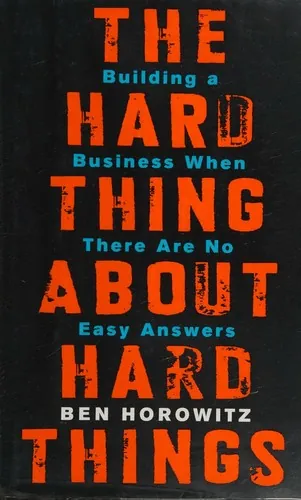
The Hard Thing About Hard Things: Building a Business When There Are No Easy Answers
by Ben Horowitz
Listen to it free. Get The Hard Thing About Hard Things on Audible with a free trial for eligible new members — cancel anytime.
Start listening freeon AudibleNew members only · many titles are included with the membership. As an Amazon Associate, Read Stacks earns from qualifying purchases and membership trials at no extra cost to you.
What this book is, and who it's for
Ben Horowitz's 2014 book is the rare business memoir written by an operator who has lived the actual hard parts — near-bankruptcy, layoffs, executive removals, strategic pivots made under existential pressure — and is honest about what they feel like from inside. Horowitz co-founded Loudcloud during the dot-com era, took the company through its near-bankruptcy in the 2000 crash, pivoted it to Opsware, and sold it to HP for $1.6 billion in 2007 before co-founding the Andreessen Horowitz venture firm. The book draws on those operating years to argue that most business books are written from outside observation and therefore omit the parts that actually matter: managing your own psychology under pressure, making decisions that hurt people you respect, communicating calibrated honesty in survival situations, and continuing to function when the rational decision would be to give up. Horowitz is famous for opening each chapter with a hip-hop lyric epigraph, treating rap as a kind of vernacular wisdom literature about operating under pressure. The book is closer to a memoir than to a manual, and it is more useful than most manuals because the memoir is honest about the parts the manuals omit. Read this when you're building something hard enough that the conventional advice keeps failing you in the specific situations where you most need it.
Horowitz's framing: the hardest parts of running a company are not the strategic ones the business books cover but the psychological ones they omit — managing your own mind under existential pressure, making decisions that hurt people you respect.
How to apply The Hard Thing About Hard Things in 3 steps
- 1Manage your own psychology under pressure
When the company / project / decision is in genuine difficulty, the biggest variable is your own mental state. Sleep enough. Eat regularly. Find one trusted person to talk honestly with. The textbook advice you read while calm fades; the mental discipline is what carries you through.
- 2Communicate calibrated honesty in survival mode
When delivering hard news to the team / partners / customers, neither full disclosure nor full opacity works. Find the level of honesty that gives them what they need to act, without producing panic. The calibration is hard precisely because both extremes feel safer in the moment.
- 3Make decisions, then own them fully
Under existential pressure, no decision is itself a decision — usually a bad one. Pick the option that seems least bad with available information. Communicate it decisively to the team. Own the outcome regardless of how it plays out. The decisiveness produces the team confidence that makes the decision work.
Opening
Chapters
- Chapter 1From Communist to Venture Capitalist1.5 min
- Chapter 2I Will Survive2 min
- Chapter 3This Time with Feeling2 min
- Chapter 4When Things Fall Apart2 min
- Chapter 5Take Care of the People, the Products, and the Profits1.5 min
- Chapter 6Concerning the Going Concern2 min
- Chapter 7How to Lead Even When You Don't Know Where You Are Going2 min
- Chapter 8First Rule of Entrepreneurship: There Are No Rules2 min
- Chapter 9The End of the Beginning2 min
Closing & reference
How to read this book. Each chapter is a ~30-second summary — the core insight, no filler. Open the chapters that grab you. If the book resonates, hear the full audiobook free with an Audible trial or buy the edition on Amazon (links below, affiliate-disclosed).
Frequently asked questions
What is The Hard Thing About Hard Things about?+
Ben Horowitz's 2014 book is the rare business memoir written by an operator who has lived the actual hard parts — near-bankruptcy, layoffs, executive removals, strategic pivots made under existential pressure — and is honest about what they feel like from inside.
How long does it take to read The Hard Thing About Hard Things?+
The full The Hard Thing About Hard Things typically takes 4-6 hours to read cover-to-cover. The Read Stacks chapter summaries cover the same ideas in ~20.5 minutes total (11 chapters at ~30 seconds each).
Who is The Hard Thing About Hard Things for?+
The Hard Thing About Hard Things is written for founders, operators, and business leaders. The ideas apply across team sizes from solo to enterprise, with case examples drawn from Ben Horowitz's direct experience.
What are the key ideas in The Hard Thing About Hard Things?+
The book covers From Communist to Venture Capitalist, I Will Survive, This Time with Feeling, When Things Fall Apart and Take Care of the People, the Products, and the Profits. Each chapter has a free summary on Read Stacks (~30 seconds each).
Is The Hard Thing About Hard Things worth reading?+
If you're interested in startups and the operator mindset, The Hard Thing About Hard Things is widely considered essential. The Read Stacks chapter summaries help you decide — read the free first chapter, then buy the full book on Amazon if the argument resonates.
Books like The Hard Thing About Hard Things
If The Hard Thing About Hard Things resonated, these non-fiction books pick up the same threads.
From Read Stacks · Learn
How to get more out of this book
Three short guides: how to take notes on a non-fiction book, how to summarise a chapter in your own words, and the retention techniques that decide whether what you read here is still useful six months from now.
- How do I take notes on a non-fiction book?
Decide what the notes are for, read a full section before writing, and use the same short layout for every chapter: claim, reasons, evidence, terms and your own response, all in your own words with page numbers. Turn each note into questions for review, and finish with a one-page summary of the whole book.
5 min read
- How do I summarise a non-fiction chapter?
Read the chapter's opening and closing pages first, write its main claim as one sentence, list the two to four reasons the author gives and the best piece of evidence, then close the book and write a short paragraph from memory. Check it against the text and add one clearly labelled line of your own.
5 min read
- I read a lot of books but can't remember anything. What works?
Forgetting most of what you read is normal, not a personal failing — your brain wasn't designed to retain prose at the rate modern readers consume it. The practices that DO work share one thing: they force you to USE the material instead of just consuming it. Six specific techniques, each tested across decades.
7 min read
Appears in these topics
The Hard Thing About Hard Things is part of this curated reading list — each a “best books on X” cluster with a synthesis on how the books fit together.