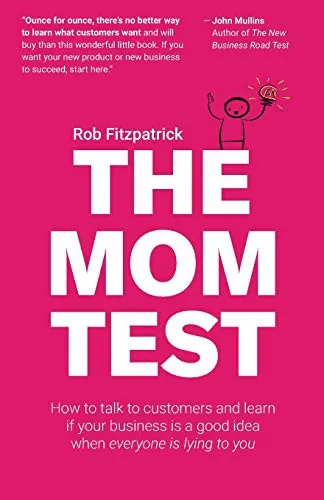
The Mom Test: How to Talk to Customers and Learn If Your Business Is a Good Idea When Everyone Is Lying to You
Listen to it free. Get The Mom Test on Audible with a free trial for eligible new members — cancel anytime.
Start listening freeon AudibleNew members only · many titles are included with the membership. As an Amazon Associate, Read Stacks earns from qualifying purchases and membership trials at no extra cost to you.
What this book is, and who it's for
Rob Fitzpatrick's 2013 book is the canonical guide for talking to customers in ways that produce useful information rather than the politeness-and-compliments that founder-customer conversations usually generate. The title heuristic is that even your mom — who loves you and wants you to succeed — cannot give useful feedback on your business idea if you ask the wrong questions, because the right questions reveal the truth and the wrong questions reveal politeness. The book walks through the specific question patterns that produce reliable data (focused on past behavior, current pain, and actual investments rather than future hypotheticals or opinions about your idea) and the casual conversational frame that lets the customer's real life surface naturally. The framework is concrete enough to apply in your next customer conversation and broadly enough useful to extend to any context where you need to learn what someone actually wants versus what they are willing to say politely. Read this when you've noticed that the positive feedback your business idea keeps receiving has not translated into actual customers, or when you're starting any project that depends on understanding what another person genuinely wants — clients, prospects, employees, partners — and you want the conversational discipline that produces real signal rather than the comfortable noise the conventional approach generates.
Fitzpatrick's heuristic for customer research: even your mom — who loves you — cannot give useful feedback on your business idea if you ask the wrong questions. The right questions ask about past behavior and actual pain; the wrong ones ask for opinions about your idea.
How to apply The Mom Test in 3 steps
- 1Stop pitching, start asking
In your next customer conversation, don't describe your idea. Ask about their actual life — recent specific instances of the problem you think you're solving. Their past behavior is the most reliable signal; their opinion of your idea is the least reliable signal.
- 2Ask about pain, money, and time
Three signals matter: (1) what specifically did this cost you the last time it happened? (2) what have you tried to solve it, and what did you pay? (3) when this happens, who else does it affect? Real problems produce real answers; imaginary problems produce vague ones.
- 3Push for commitment at every meeting
End every customer conversation with a specific next step that requires their commitment — money, time, introduction, written agreement. Compliments cost nothing and predict nothing. Commitment costs something and predicts everything. If you can't get commitment, you don't have a customer; you have a polite conversation.
Chapters
How to read this book. Each chapter is a ~30-second summary — the core insight, no filler. Open the chapters that grab you. If the book resonates, hear the full audiobook free with an Audible trial or buy the edition on Amazon (links below, affiliate-disclosed).
Frequently asked questions
What is The Mom Test about?+
Rob Fitzpatrick's 2013 book is the canonical guide for talking to customers in ways that produce useful information rather than the politeness-and-compliments that founder-customer conversations usually generate.
How long does it take to read The Mom Test?+
The full The Mom Test typically takes 4-6 hours to read cover-to-cover. The Read Stacks chapter summaries cover the same ideas in ~12.5 minutes total (7 chapters at ~30 seconds each).
Who is The Mom Test for?+
The Mom Test is written for founders, operators, and business leaders. The ideas apply across team sizes from solo to enterprise, with case examples drawn from Rob Fitzpatrick's direct experience.
What are the key ideas in The Mom Test?+
The book covers The Mom Test, Avoiding Bad Data, Asking Important Questions, Keeping It Casual and Commitment and Advancement. Each chapter has a free summary on Read Stacks (~30 seconds each).
Is The Mom Test worth reading?+
If you're interested in startups and the operator mindset, The Mom Test is widely considered essential. The Read Stacks chapter summaries help you decide — read the free first chapter, then buy the full book on Amazon if the argument resonates.
Books like The Mom Test
If The Mom Test resonated, these non-fiction books pick up the same threads.
From Read Stacks · Learn
How to get more out of this book
Three short guides: how to take notes on a non-fiction book, how to summarise a chapter in your own words, and the retention techniques that decide whether what you read here is still useful six months from now.
- How do I take notes on a non-fiction book?
Decide what the notes are for, read a full section before writing, and use the same short layout for every chapter: claim, reasons, evidence, terms and your own response, all in your own words with page numbers. Turn each note into questions for review, and finish with a one-page summary of the whole book.
5 min read
- How do I summarise a non-fiction chapter?
Read the chapter's opening and closing pages first, write its main claim as one sentence, list the two to four reasons the author gives and the best piece of evidence, then close the book and write a short paragraph from memory. Check it against the text and add one clearly labelled line of your own.
5 min read
- I read a lot of books but can't remember anything. What works?
Forgetting most of what you read is normal, not a personal failing — your brain wasn't designed to retain prose at the rate modern readers consume it. The practices that DO work share one thing: they force you to USE the material instead of just consuming it. Six specific techniques, each tested across decades.
7 min read
Appears in these topics
The Mom Test is part of this curated reading list — each a “best books on X” cluster with a synthesis on how the books fit together.