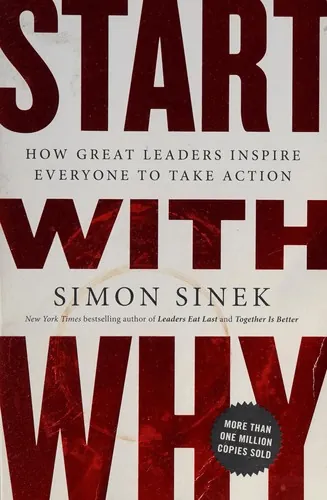
Start with Why: How Great Leaders Inspire Everyone to Take Action
by Simon Sinek
Listen to it free. Get Start with Why on Audible with a free trial for eligible new members — cancel anytime.
Start listening freeon AudibleNew members only · many titles are included with the membership. As an Amazon Associate, Read Stacks earns from qualifying purchases and membership trials at no extra cost to you.
What this book is, and who it's for
Simon Sinek's 2009 book grew out of one of the most-watched TED talks of all time and argues that the organizations that build durable loyalty — among customers, employees, and partners — communicate from the inside out. Sinek's Golden Circle model places Why (the purpose or belief that the work serves) at the center, How (the methods that differentiate the organization) around it, and What (the products and outputs) on the outside. Most organizations communicate outside-in, leading with What they make; the exceptional ones lead with Why they exist. Drawing on case studies from Apple, the Wright brothers, Martin Luther King Jr., and Southwest Airlines, Sinek argues that the inside-out order is not stylistic but maps to how the human brain actually decides — limbic identity-based decisions come first, neocortex rationalization comes second. Read this when you've noticed that your organization's strategic decisions default to imitating competitors rather than expressing a coherent purpose, or when you're trying to articulate why your career, project, or company exists in a way that would survive your own departure.
Sinek's three concentric circles: Why (purpose) at the center, How (methods) around it, What (products) on the outside. Durable organizations communicate inside-out (Why first); most communicate outside-in (What first), which produces information without inspiration.
How to apply Start with Why in 3 steps
- 1Articulate your Why
For your organization, your career, or a major project, write down WHY it exists — the purpose beyond the product or activity. Most attempts will produce marketing language on first pass; iterate until you have a sentence that explains your actual past decisions, not your aspirational ones.
- 2Audit your communication for inside-out order
Look at your last presentation, pitch, or website. Does it lead with What you make (outside-in) or Why you exist (inside-out)? Most communications default to outside-in. Reorder one key communication to lead with Why; watch the response shift.
- 3Hire and decide from Why
When making hires or strategic decisions, ask: does this person / decision align with the Why? Hiring against your Why dilutes the team's purpose. Strategic decisions misaligned with Why erode the brand even when individually profitable. The Why is the filter that compounds.
Chapters
- Chapter 1Assume You Know1.5 min
- Chapter 2Carrots and Sticks1.5 min
- Chapter 3The Golden Circle1.5 min
- Chapter 4This Is Not Opinion, This Is Biology1.5 min
- Chapter 5Clarity, Discipline, and Consistency1.5 min
- Chapter 6The Emergence of Trust1.5 min
- Chapter 7How a Tipping Point Tips1.5 min
- Chapter 8Start with Why, But Know How1.5 min
- Chapter 9Know Why. Know How. Then What?1.5 min
- Chapter 10Communication Is Not About Speaking, It's About Listening1.5 min
- Chapter 11When Why Goes Fuzzy1.5 min
- Chapter 12Split Happens2 min
- Chapter 13The Origins of a Why2 min
How to read this book. Each chapter is a ~30-second summary — the core insight, no filler. Open the chapters that grab you. If the book resonates, hear the full audiobook free with an Audible trial or buy the edition on Amazon (links below, affiliate-disclosed).
Frequently asked questions
What is Start with Why about?+
Simon Sinek's 2009 book grew out of one of the most-watched TED talks of all time and argues that the organizations that build durable loyalty — among customers, employees, and partners — communicate from the inside out.
How long does it take to read Start with Why?+
The full Start with Why typically takes 4-6 hours to read cover-to-cover. The Read Stacks chapter summaries cover the same ideas in ~21.5 minutes total (13 chapters at ~30 seconds each).
Who is Start with Why for?+
Start with Why is widely regarded as essential reading in its field. The Read Stacks summary is the fastest way to decide if the full book is worth your time before committing to it.
What are the key ideas in Start with Why?+
The book covers Assume You Know, Carrots and Sticks, The Golden Circle, This Is Not Opinion, This Is Biology and Clarity, Discipline, and Consistency. Each chapter has a free summary on Read Stacks (~30 seconds each).
Is Start with Why worth reading?+
If you're interested in the ideas in Start with Why, Start with Why is widely considered essential. The Read Stacks chapter summaries help you decide — read the free first chapter, then buy the full book on Amazon if the argument resonates.
Books like Start with Why
If Start with Why resonated, these non-fiction books pick up the same threads.
From Read Stacks · Learn
How to get more out of this book
Three short guides: how to take notes on a non-fiction book, how to summarise a chapter in your own words, and the retention techniques that decide whether what you read here is still useful six months from now.
- How do I take notes on a non-fiction book?
Decide what the notes are for, read a full section before writing, and use the same short layout for every chapter: claim, reasons, evidence, terms and your own response, all in your own words with page numbers. Turn each note into questions for review, and finish with a one-page summary of the whole book.
5 min read
- How do I summarise a non-fiction chapter?
Read the chapter's opening and closing pages first, write its main claim as one sentence, list the two to four reasons the author gives and the best piece of evidence, then close the book and write a short paragraph from memory. Check it against the text and add one clearly labelled line of your own.
5 min read
- I read a lot of books but can't remember anything. What works?
Forgetting most of what you read is normal, not a personal failing — your brain wasn't designed to retain prose at the rate modern readers consume it. The practices that DO work share one thing: they force you to USE the material instead of just consuming it. Six specific techniques, each tested across decades.
7 min read
Appears in these topics
Start with Why is part of 2 curated reading lists — each a “best books on X” cluster with a synthesis on how the books fit together.