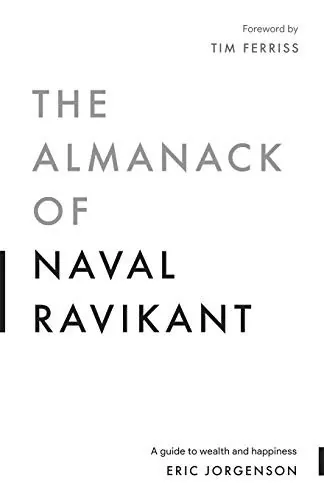
The Almanack of Naval Ravikant: A Guide to Wealth and Happiness
Listen to it free. Get The Almanack of Naval Ravikant on Audible with a free trial for eligible new members — cancel anytime.
Start listening freeon AudibleNew members only · many titles are included with the membership. As an Amazon Associate, Read Stacks earns from qualifying purchases and membership trials at no extra cost to you.
What this book is, and who it's for
Eric Jorgenson's 2020 book is an unusual artifact: a curation of Naval Ravikant's tweets, podcast appearances, and interviews compiled into a single volume with Naval's blessing. The Almanack does not have a single narrative arc; instead it organizes the recurring themes of Naval's public thinking into chapters on wealth, judgement, happiness, and philosophy. The book's most-famous material is the 2018 tweetstorm-turned-essay on building wealth, which argues that wealth is built by acquiring specific knowledge, with accountability, applied through leverage, with patience over long timeframes — and that modern leverage (code and media, with zero marginal cost to replicate) has fundamentally changed who can play the game. The second half of the book pivots to happiness, treating it as a skill built by reducing desire rather than acquiring more, with influences from Buddhism, Stoicism, and a small set of philosophical sources Naval returns to repeatedly. Read this when you've noticed that the conventional career advice (work hard, save aggressively, retire someday) does not match how anyone you actually admire has organized their life, and you want a compressed framework for thinking about wealth and happiness as separate-but-related projects.
Naval Ravikant's wealth-building formula: acquire knowledge that cannot be taught (specific knowledge), with accountability, applied through modern zero-marginal-cost leverage (code and media), with patience over long timeframes.
How to apply The Almanack of Naval Ravikant in 3 steps
- 1Find your specific knowledge
What can you learn that cannot be taught — that emerged from your specific curiosity, your specific path, your specific obsessions? Specific knowledge is what the market eventually rewards because it can't be commoditized. Identify yours; deepen it across years.
- 2Apply zero-marginal-cost leverage
Code and media replicate without unit cost. For your specific knowledge to compound into wealth, deploy it through code, content, or both — products that work while you sleep, writing that reaches new readers without your involvement. The leverage is what turns knowledge into wealth.
- 3Build the happiness practice alongside the wealth practice
Naval is explicit that wealth doesn't automatically produce happiness. Run the happiness work in parallel: meditation, examining desires, reducing the wants that drive the wealth chase. Without the happiness practice, the wealth practice produces only more wealth chase.
Opening
Chapters
How to read this book. Each chapter is a ~30-second summary — the core insight, no filler. Open the chapters that grab you. If the book resonates, hear the full audiobook free with an Audible trial or buy the edition on Amazon (links below, affiliate-disclosed).
Frequently asked questions
What is The Almanack of Naval Ravikant about?+
Eric Jorgenson's 2020 book is an unusual artifact: a curation of Naval Ravikant's tweets, podcast appearances, and interviews compiled into a single volume with Naval's blessing.
How long does it take to read The Almanack of Naval Ravikant?+
The full The Almanack of Naval Ravikant typically takes 4-6 hours to read cover-to-cover. The Read Stacks chapter summaries cover the same ideas in ~14.5 minutes total (8 chapters at ~30 seconds each).
Who is The Almanack of Naval Ravikant for?+
The Almanack of Naval Ravikant is for readers wanting practical philosophy — ideas you can apply in difficult moments, not abstract theory. Background in philosophy is not assumed; the writing is accessible.
What are the key ideas in The Almanack of Naval Ravikant?+
The book covers How to Get Rich Without Getting Lucky, Building Judgement, Learning Happiness, Saving Yourself and Philosophy. Each chapter has a free summary on Read Stacks (~30 seconds each).
Is The Almanack of Naval Ravikant worth reading?+
If you're interested in the ideas in The Almanack of Naval Ravikant, The Almanack of Naval Ravikant is widely considered essential. The Read Stacks chapter summaries help you decide — read the free first chapter, then buy the full book on Amazon if the argument resonates.
Books like The Almanack of Naval Ravikant
If The Almanack of Naval Ravikant resonated, these non-fiction books pick up the same threads.

From Read Stacks · Learn
How to get more out of this book
Three short guides: how to take notes on a non-fiction book, how to summarise a chapter in your own words, and the retention techniques that decide whether what you read here is still useful six months from now.
- How do I take notes on a non-fiction book?
Decide what the notes are for, read a full section before writing, and use the same short layout for every chapter: claim, reasons, evidence, terms and your own response, all in your own words with page numbers. Turn each note into questions for review, and finish with a one-page summary of the whole book.
5 min read
- How do I summarise a non-fiction chapter?
Read the chapter's opening and closing pages first, write its main claim as one sentence, list the two to four reasons the author gives and the best piece of evidence, then close the book and write a short paragraph from memory. Check it against the text and add one clearly labelled line of your own.
5 min read
- I read a lot of books but can't remember anything. What works?
Forgetting most of what you read is normal, not a personal failing — your brain wasn't designed to retain prose at the rate modern readers consume it. The practices that DO work share one thing: they force you to USE the material instead of just consuming it. Six specific techniques, each tested across decades.
7 min read
Appears in these topics
The Almanack of Naval Ravikant is part of this curated reading list — each a “best books on X” cluster with a synthesis on how the books fit together.